Complete Homeowner and Electrician Guide to 20 Amp Circuit Capacity, Safe Load Limits, Wiring Requirements, and Breaker Selection
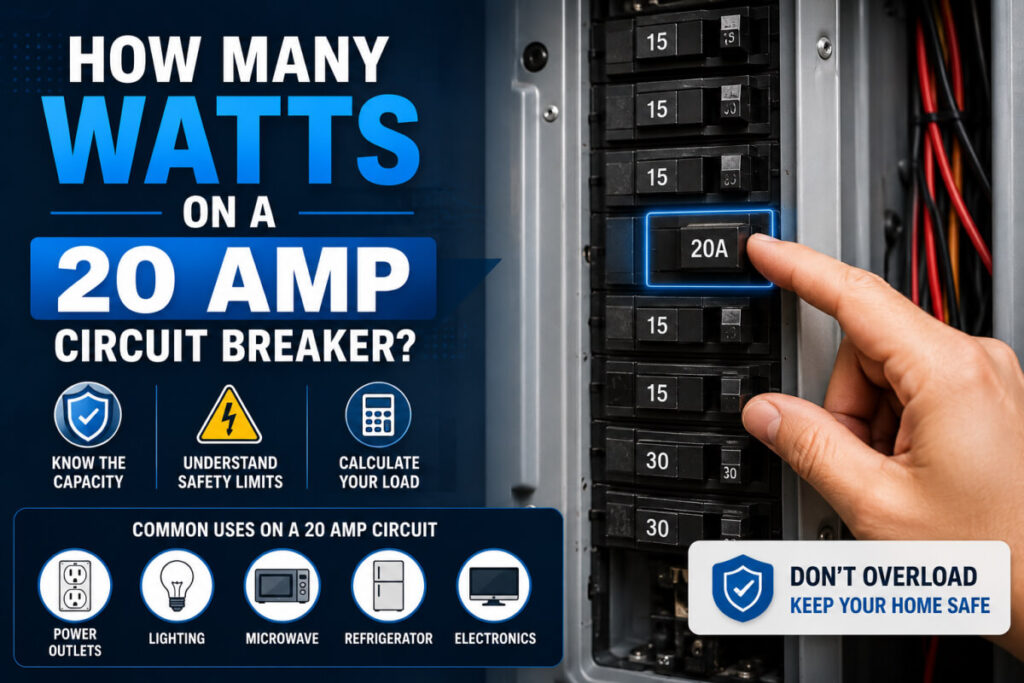
One of the most common electrical questions homeowners and DIY electricians ask is: how many watts on a 20 amp circuit breaker can I safely run? Whether you’re adding a new outlet, planning a kitchen appliance circuit, or troubleshooting a tripping breaker, understanding the wattage capacity of a 20 amp circuit is essential for safe and code-compliant electrical work.
A 20 amp circuit breaker handles more load than the standard 15 amp circuit found in most bedrooms and living rooms, making it the right choice for kitchens, garages, bathrooms, and dedicated appliance circuits. But knowing the maximum watts on a 20 amp circuit — and the safe working limit — is what separates a reliable installation from a fire hazard.
In this guide, we’ll cover exactly how many watts a 20 amp breaker can handle, how to calculate amps to watts, how it compares to 15 amp and 30 amp circuits, what wiring it requires, and which breakers and outlets work best for 20 amp circuits.
How Many Watts on a 20 Amp Circuit Breaker?
The answer starts with a simple formula. To understand watts, amps, and volts, you need to know the basic amperage equation used by electricians worldwide:
Watts = Amps × Volts
For a standard 120V, 20 amp circuit in the United States:
20 amps × 120 volts = 2,400 watts maximum
So, 20 amps is how many watts? At 120V, it’s 2,400 watts. The 20 amp breaker wattage ceiling — the absolute max wattage on a 20 amp circuit — is 2,400W, and this figure also answers questions like “how many watts are in a 20 amp circuit,” “how many watts in a 20 amp circuit,” “how many watts on a 20 amp breaker,” and “20 amp wattage.” They all point to the same answer: 2,400 watts at 120V. However, the NEC (National Electrical Code) requires circuits to operate at no more than 80% of their rated capacity for continuous loads — anything running for 3 hours or more. This means the safe working limit, or maximum wattage on a 20 amp circuit for continuous use, is:
2,400 watts × 80% = 1,920 watts safe continuous load
This 1,920-watt figure is the maximum watts on a 20 amp circuit you should plan for any load that runs for extended periods. It also answers “how many watts can a 20 amp circuit handle” for continuous applications — and it’s the number that matters most when sizing kitchen circuits, bathroom circuits, and garage workshop circuits.
How Many Watts Is 20 Amps on a 240V Circuit?
For 240V circuits — used for dryers, ranges, air conditioners, and EV chargers — the wattage calculation changes significantly. How many watts on a 20 amp 240V circuit?
20 amps × 240 volts = 4,800 watts maximum
A 240V 20 amp breaker — which requires a two-pole 20 amp breaker — can deliver up to 4,800 watts, with a safe continuous load of 3,840 watts. This is why 240V circuits are used for high-draw appliances that would require multiple 120V circuits to power safely.
How to Calculate Amps to Watts (and Watts to Amps)
Knowing how to calculate amps to watts — and reverse the formula — is a fundamental skill for any homeowner managing electrical loads. Here are the three most useful versions of the amperage equation:
Electrical Calculation Formulas
- Watts to Amps: Amps = Watts ÷ Volts | Example: 1,200W ÷ 120V = 10 amps
- Amps to Watts: Watts = Amps × Volts | Example: 20A × 120V = 2,400 watts
- Amps to Watts (240V): Watts = Amps × Volts | Example: 20A × 240V = 4,800 watts
These formulas apply whether you’re calculating the load on a single outlet, planning a new circuit, or using an amperage conversion chart to verify appliance compatibility. The amps formula — Watts = Amps × Volts — is also written as the amperage equation W = A × V, and it works the same way whether you need to find watts from amps or calculate amps with watts and volts. When you need to calculate amps with watts and volts, simply divide: Amps = Watts ÷ Volts.
For example, a 2,000-watt appliance — a common benchmark for space heaters and some microwaves — draws 2,000 ÷ 120 = 16.7 amps on a 120V circuit. That’s within a 20 amp breaker’s rating, which is why a 20 amp circuit is the correct choice for a 2,000 watt amp draw. On a 15 amp circuit (max 1,800 watts), that same appliance would trip the breaker immediately.
20 Amp vs. 15 Amp vs. 30 Amp: Wattage Comparison
Understanding how a 20 amp circuit compares to other common breaker ratings helps you choose the right circuit for each application. Here’s a full comparison of how many watts is 15 amps vs 20 amps vs 30 amps at both 120V and 240V:
| Breaker Size | Voltage | Max Watts | Safe Load (80%) | Typical Use |
|---|---|---|---|---|
| 15 Amp | 120V | 1,800W | 1,440W | Bedrooms, living rooms, general lighting |
| 20 Amp | 120V | 2,400W | 1,920W | Kitchens, bathrooms, garages, appliances |
| 20 Amp | 240V | 4,800W | 3,840W | AC units, EV chargers, workshop tools |
| 30 Amp | 240V | 7,200W | 5,760W | Dryers, water heaters, large HVAC |
| 50 Amp | 240V | 12,000W | 9,600W | Electric ranges, EV fast chargers |
As you can see, a 15 amp circuit breaker handles 1,800 watts max — about 600 watts less than a 20 amp breaker at the same voltage. A breaker 20 amp rated device gives you the extra headroom needed for high-draw appliances that a 15 amp circuit simply cannot support reliably. Understanding watts units — where one watt equals one joule per second of electrical power — also helps you read appliance energy labels and interpret utility bills more accurately. The difference between circuit types becomes clear in 20 amp circuit watts capacity versus 15 amp circuit watts capacity when you’re running appliances like microwaves, coffee makers, toasters, or power tools that can each draw 800–1,500 watts on their own.
What Can You Run on a 20 Amp Circuit?
Knowing how many watts can a 20 amp breaker handle is only useful if you know what common appliances and devices actually draw. Here’s a practical breakdown of typical loads on a 20 amp circuit:
Kitchen Appliances
Microwaves (900–1,500W), coffee makers (800–1,200W), toasters (800–1,400W), and electric kettles (1,000–1,500W) are all commonly run on dedicated 20 amp kitchen circuits. The NEC requires at least two 20 amp small appliance circuits in kitchens for exactly this reason.
Bathroom and Garage
Hair dryers (1,200–1,875W), space heaters (750–1,500W), and power tools like circular saws (1,400–1,800W) all require 20 amp circuits. NEC code mandates dedicated 20 amp circuits for bathrooms and garages.
HVAC and Cooling
Window air conditioners (700–1,500W), portable AC units (900–1,400W), and dehumidifiers (300–800W) are commonly served by 20 amp circuits. Larger central AC systems require 240V circuits. See our guide on AC contactor diagnosis and replacement for HVAC electrical maintenance tips.
Home Office and Electronics
Desktop computers (150–400W), monitors (20–100W), and laser printers (300–500W) are well within 20 amp limits but should still be on dedicated circuits to avoid sharing with high-draw devices.
Workshop and Outdoor
Bench grinders (500–1,000W), compressors (750–2,000W), and pressure washers (1,000–1,800W) often push right to the edge of 20 amp capacity. Dedicated circuits are strongly recommended for any stationary power tool.
What Is a Standard Outlet Wattage?
A standard 120V outlet on a 15 amp circuit handles up to 1,800 watts, while a standard outlet on a 20 amp circuit handles up to 2,400 watts. The outlets look slightly different — 20 amp outlets have a T-shaped neutral slot to distinguish them from 15 amp receptacles.
What Wire Does a 20 Amp Circuit Require?
The circuit breaker and the wire gauge must always be matched. A 20 amp breaker requires 12-gauge wire (12 AWG) — never 14-gauge, which is only rated for 15 amp circuits. Using undersized wire on a 20 amp breaker is a serious fire hazard because the breaker won’t trip before the wire overheats.
12/2 vs 12/3 Wire for 20 Amp Circuits
For standard 120V 20 amp circuits, 12/2 Romex (two conductors plus a ground) is the standard choice. For circuits requiring a neutral and two hot legs — such as multi-wire branch circuits or 240V applications — 12/3 wire (three conductors plus a ground) is required. The Dvolt product range includes MCB circuit breakers rated for the proper current capacities to pair with these wire gauges.
20 Amp Outlet Requirements
A 20 amp outlet is identified by a T-shaped neutral slot. Standard 15 amp outlets can be used on 20 amp circuits (they are rated for pass-through up to 20 amps), but any outlet serving as the only receptacle on a dedicated 20 amp circuit should be a 20 amp-rated receptacle. Knowing how do I know what amp my outlet is is simple: look for that T-slot on the neutral side.
Choosing the Right 20 Amp Breaker
Not all 20 amp breakers are interchangeable. Breaker compatibility depends on the electrical panel manufacturer. Using the wrong brand or series in a panel can create arcing, overheating, and code violations — even if the breaker physically fits.
Single-Pole vs. Two-Pole 20 Amp Breakers
A single-pole 20 amp breaker controls one 120V hot leg and is used for standard outlets, kitchen circuits, and bathroom circuits. A two-pole 20 amp breaker — such as the Square D 20 amp double-pole or a two-pole 20 amp breaker from Dvolt’s lineup — controls two 120V hot legs to deliver 240V and is used for air conditioners, EV chargers, and workshop subpanels. Browse Dvolt’s full range of 20 amp breakers and MCB devices to find the right fit for your panel.
GFCI and AFCI Protection on 20 Amp Circuits
The NEC requires GFCI protection on all 20 amp circuits in kitchens, bathrooms, garages, and outdoor locations. AFCI protection is required on bedroom and living area circuits. These protections can be built into the breaker itself or provided at the outlet. If you need help selecting the right protective device, review Dvolt’s guide on how to change a circuit breaker safely for panel-level installation guidance.
Common Mistakes on 20 Amp Circuits
- Using 14-gauge wire on a 20 amp breaker — always use 12 AWG or heavier
- Overloading the circuit by adding too many high-draw appliances on one branch
- Ignoring the 80% continuous load rule, which causes repeated nuisance tripping
- Installing a 20 amp breaker to “fix” a frequently tripping 15 amp breaker without investigating the root cause
- Using incompatible breaker brands in the electrical panel
- Skipping GFCI protection in kitchens, bathrooms, and garages
- Forgetting to account for appliance inrush current when planning circuit loads
Frequently Asked Questions
How Many Watts Can a 20 Amp Breaker Handle?
A 20 amp breaker on a 120V circuit can handle a maximum of 2,400 watts. The safe continuous load limit per NEC code is 1,920 watts (80% of maximum). On a 240V circuit, a 20 amp breaker handles up to 4,800 watts with a safe continuous limit of 3,840 watts.
How Many Watts Is 15 Amps vs. 20 Amps?
A 15 amp circuit at 120V handles a maximum of 1,800 watts (1,440W safe continuous load). A 20 amp circuit at 120V handles 2,400 watts (1,920W safe continuous). The 20 amp circuit gives you an additional 600 watts of headroom, which is significant when running appliances like microwaves or hair dryers.
What Is the Maximum Wattage on a 20 Amp Circuit?
The absolute maximum wattage on a 20 amp circuit is 2,400 watts at 120V. However, for any load running continuously (3+ hours), the NEC-required safe maximum is 1,920 watts. Always design circuits to the 80% rule to prevent overheating and nuisance tripping.
How Do I Know If My Outlet Is 15 or 20 Amps?
Look at the neutral (left) slot of the outlet. A standard 15 amp outlet has a straight vertical slot. A 20 amp outlet has a T-shaped neutral slot with a horizontal notch. You can also check the breaker in your panel — if it’s labeled 20A, the circuit is 20 amps. For outlet installation guidance, see our complete homeowner circuit guide.
Can a 20 Amp Circuit Run a 2,000-Watt Appliance?
Yes — a 2,000-watt appliance draws approximately 16.7 amps on a 120V circuit, which is within the 20-amp breaker’s rating and just under the 80% continuous load limit of 1,920 watts. However, avoid running other significant loads on the same circuit simultaneously, as the combined draw could exceed the breaker’s safe capacity.
Need a 20 Amp Circuit Breaker?
Dvolt offers a complete range of 20 amp single-pole and two-pole circuit breakers, MCBs, and panel protection devices built for residential and commercial electrical systems — designed for reliable performance and code compliance.
Contact Our Team Browse Circuit BreakersFinal Thoughts
Understanding how many watts on a 20 amp circuit breaker you can safely run is one of the most practical pieces of electrical knowledge any homeowner can have. The math is straightforward — 2,400 watts maximum, 1,920 watts for continuous loads — but applying it correctly means accounting for inrush current, NEC code requirements, wire gauge, and breaker compatibility.
Whether you’re troubleshooting a tripping breaker, planning a kitchen renovation, adding a garage circuit, or selecting the right two-pole 20 amp breaker for a 240V appliance, the principles in this guide give you a solid foundation. For more electrical circuit guidance, read our related articles on how to change a circuit breaker safely and how to properly ground a circuit breaker panel.
If you’re unsure whether a circuit is properly sized, consistently tripping, or due for an upgrade, contact a licensed electrician — or reach out to Dvolt’s team for help selecting the right breaker for your application.