
A Complete Guide to Understanding MCBs, Their Working Principles, Types, and Applications
Every day, your home’s electrical system works tirelessly—powering lights, refrigerators, air conditioners, and countless other appliances. But have you ever paused to consider what’s actually keeping us safe within all those wires? What happens when something goes wrong? What protects your valuable electronics and, more importantly, your family from electrical hazards?
Enter the Miniature Circuit Breaker (MCB)—a small but mighty guardian that stands between your electrical devices and potential disaster. Unlike the traditional fuses that our grandparents relied on, MCBs offer superior protection with the convenience of being reusable.
In this comprehensive guide, we’ll explore everything you need to know about MCBs, from how they work to choosing the right one for your needs.
What is a Miniature Circuit Breaker (MCB)?
A Miniature Circuit Breaker (MCB) is an automatically operated electrical switch designed to protect electrical circuits from damage caused by excess current, typically resulting from overload or short circuit conditions. Think of it as an intelligent safety device that monitors the current flowing through your electrical circuit and immediately cuts off power when it detects dangerous conditions.
Key Characteristics of MCBs:
- Automatic Operation: Switches off automatically when abnormal conditions are detected
- Reusable: Can be reset manually after tripping, unlike fuses which must be replaced
- Electromechanical Design: Combines mechanical switching with electrical sensing
- Fast Response Time: Reacts within milliseconds to protect circuits
- Maintenance-Free: Requires minimal upkeep and offers long service life
Protect Your Electrical Systems Today
Explore DVOLT’s range of certified, high-quality MCBs
Browse MCB Collection →Why MCBs Have Replaced Traditional Fuses
In the past, fuses were the primary protection devices in electrical systems. However, MCBs have largely replaced them for several compelling reasons:
Limitations of Fuses
- Single-Use: Once a fuse blows, it must be completely replaced
- Time-Consuming: Requires keeping spare fuses and manually replacing them
- Imprecise Protection: May not trip at exact rated current
- Safety Concerns: Risk of using incorrect fuse ratings
- Difficult Fault Detection: Not always obvious which fuse has blown
Advantages of MCBs
- Quick Recovery: Simply flip the switch to restore power after addressing the fault
- Cost-Effective: No need to purchase replacement components
- Precise Protection: Trips at specific current ratings
- Easy Fault Detection: Tripped switch clearly indicates which circuit has a problem
- Enhanced Safety: No exposed metallic parts during operation
- Better Sensitivity: Can distinguish between temporary surges and genuine faults
How Does an MCB Work? Understanding the Protection Mechanism
An MCB employs two distinct protection mechanisms to safeguard your electrical circuits:
1. Protection Against Overload (Thermal Protection)
The Bimetallic Strip Mechanism:
Inside every MCB is a bimetallic strip—a clever component made of two different metals (typically steel and copper) bonded together. Here’s how it works:
- Normal Conditions: When current flows within safe limits, the strip remains cool and in its original shape
- Overload Detection: When current exceeds the rated capacity, the strip heats up due to increased electrical resistance
- Thermal Response: The two metals expand at different rates, causing the strip to bend or deflect
- Circuit Interruption: This deflection releases a mechanical latch, which opens the circuit contacts and stops current flow
Important: This thermal protection responds relatively slowly (within seconds), which is perfect for overload conditions that develop gradually. This allows the MCB to tolerate brief, harmless current spikes without nuisance tripping.
2. Protection Against Short Circuits (Magnetic Protection)
The Solenoid Mechanism:
For sudden, dangerous surges like short circuits, MCBs use an electromagnetic coil (solenoid):
- Instant Detection: When a short circuit occurs, current spikes dramatically
- Magnetic Field Generation: The sudden high current creates a powerful magnetic field in the solenoid
- Rapid Response: This magnetic force pushes a plunger that immediately trips the latch
- Ultra-Fast Disconnection: The circuit breaks in less than 0.1 seconds (100 milliseconds)
Key Insight: The combination of thermal and magnetic protection ensures MCBs can handle both gradual overloads and sudden short circuits, providing comprehensive protection for your electrical systems.
The Complete Operating Sequence
- Normal Operation: Current flows through the MCB’s contacts, bimetallic strip, and electromagnetic coil
- Overload Detected: Bimetallic strip heats and bends, triggering the release mechanism
- Short Circuit Detected: Electromagnetic coil generates instant magnetic field, pushing plunger to trip latch
- Contacts Open: Moving contact separates from fixed contact, breaking the circuit
- Arc Extinction: Arc chutes divide and cool the electrical arc formed during contact separation
- Manual Reset: After fault is cleared, operator manually resets the MCB to restore power
Understanding Electrical Hazards: Overload vs. Short Circuit
To appreciate how MCBs protect you, it’s important to understand the two main electrical hazards:
Overload Conditions
An overload occurs when the electrical current flowing through a circuit exceeds its designed capacity. Common causes include:
- Connecting too many appliances to a single circuit
- Using appliances that draw more power than the circuit can handle
- Voltage fluctuations that increase current demand
- Deteriorated electrical connections increasing resistance
- Undersized wiring for the connected load
Consequences of Overload:
- Overheating of electrical wires
- Insulation damage over time
- Increased fire risk
- Premature aging of electrical equipment
- Damage to sensitive electronics
- Reduced efficiency and increased energy costs
Short Circuit Conditions
A short circuit happens when electrical current takes an unintended path of very low resistance, bypassing the normal load. This can occur due to:
- Damaged wire insulation allowing conductors to touch
- Faulty electrical appliances
- Moisture ingress in electrical connections
- Physical damage to wiring (from drilling, rodents, etc.)
- Manufacturing defects in electrical equipment
- Loose or improperly connected wires
Consequences of Short Circuit:
- Sudden, massive current surge (can be thousands of amperes)
- Intense heat generation within milliseconds
- Risk of electrical fires and explosions
- Severe damage to electrical equipment
- Electric shock hazards
- Arc flash incidents causing severe burns
Internal Components of a Miniature Circuit Breaker
Understanding the anatomy of an MCB helps appreciate its sophisticated design:
- Incoming Terminal: Connection point for the power supply
- Outgoing Terminal: Connection point to the protected circuit
- Bimetallic Strip: Provides thermal (overload) protection
- Bimetallic Strip Carrier: Holds and positions the bimetallic strip
- Electromagnetic Coil (Solenoid): Provides magnetic (short circuit) protection
- Plunger: Mechanical component pushed by magnetic field to trip the mechanism
- Trip Mechanism (Latch): Mechanical device that releases to open the contacts
- Fixed Contact: Stationary electrical contact
- Moving Contact (Dynamic Contact): Mobile contact that separates to break circuit
- Arc Chutes: Extinguish the electrical arc formed when contacts separate
- Arc Chutes Holder: Houses and positions the arc chutes
- Operating Handle (Switch): Manual switch for ON/OFF control and resetting
- DIN Rail Holder: Standard mounting system for electrical panels
Arc Chutes Explained: When electrical contacts separate under load, an electric arc forms. Arc chutes divide this arc into smaller segments, cool it, and extinguish it quickly. This prevents damage to the MCB and ensures safe circuit interruption.
Types of MCBs: Choosing the Right Trip Curve
MCBs are categorized by their trip curves, which determine how sensitive they are to overcurrent conditions. The trip curve indicates the multiple of rated current at which the MCB will trip instantaneously.
Type A MCB
Trip Characteristic
Most sensitive (2-3x rated current)
Applications
- Semiconductor manufacturing equipment
- Precision electronics
- Circuits with sensitive components
- Laboratory equipment
Type B MCB
Trip Characteristic
Medium sensitivity (3-5x rated current)
Applications
- Residential lighting circuits
- Heating systems without high inrush
- Cable protection
- General-purpose residential circuits
Type C MCB ⭐
Trip Characteristic
Standard sensitivity (5-10x rated current) – MOST COMMON
Applications
- Domestic appliances
- Commercial installations
- Transformers
- Fluorescent and LED lighting
- Office equipment
- HVAC systems
Type D MCB
Trip Characteristic
Low sensitivity (10-20x rated current)
Applications
- Electric motors
- Welding equipment
- Industrial machinery
- Heavy-duty power tools
Type K MCB
Trip Characteristic
Specialized for motors (8-12x rated current)
Applications
- Industrial compressors
- Large winding motors
- X-ray machines
- Heavy industrial equipment
Type Z MCB
Trip Characteristic
Highly sensitive (2-3x rated current)
Applications
- Electronic circuits
- Semiconductor devices
- Specialized industrial applications
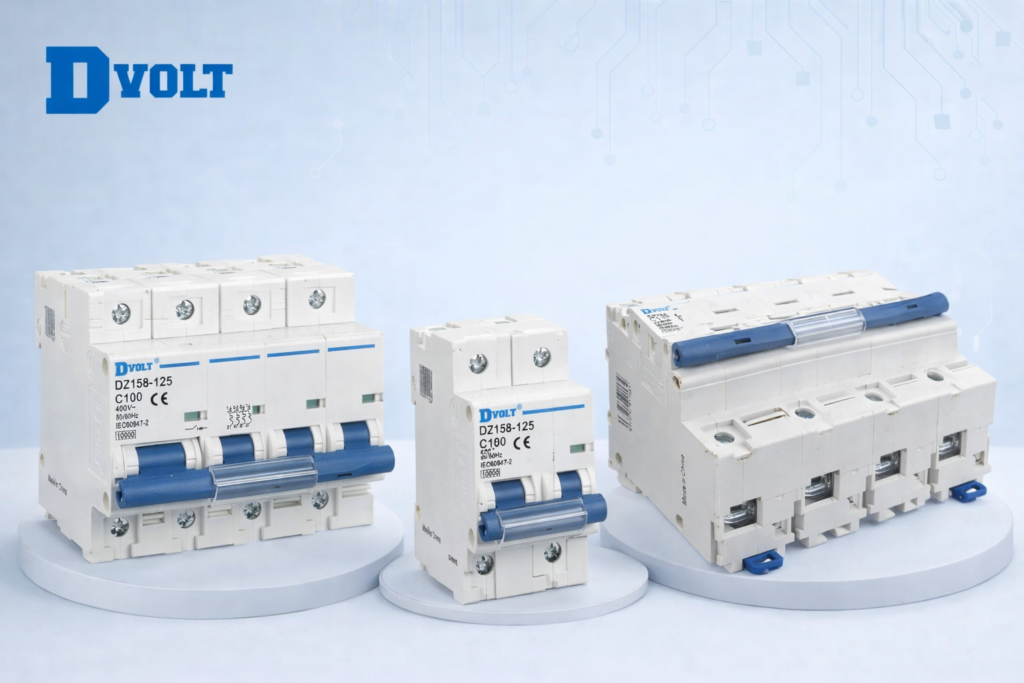
Popular DVOLT Type C MCBs:
Common Applications of MCBs
MCBs are essential safety devices found across various settings:
Residential Applications
- Lighting circuits
- Kitchen appliances
- Air conditioning systems
- Water heaters
- Washing machines
- Entertainment systems
- Home office equipment
- Swimming pool pumps
Commercial Applications
- Office buildings
- Retail stores
- Restaurant equipment
- Commercial HVAC
- Security systems
- Elevators
- Shopping malls
- Hotels
Industrial Applications
- Manufacturing equipment
- Motor control centers
- Industrial lighting
- Control panels
- Process automation
- Material handling
- Conveyor systems
- CNC machines
Specialized Applications
- Solar power systems
- EV charging stations
- Data centers
- Telecommunications
- Healthcare facilities
- Educational institutions
- Agricultural equipment
- Marine installations
Find the Perfect MCB for Your Application
Browse our comprehensive range of MCBs for residential, commercial, and industrial use
View All MCBs →Benefits of Using MCBs in Modern Electrical Systems
1. Enhanced Safety
MCBs significantly reduce the risk of electrical fires, electric shocks, and equipment damage by immediately responding to dangerous current conditions.
2. Operational Convenience
Simply reset the switch after addressing the fault—no replacement parts needed.
3. Cost-Effectiveness
Higher initial cost but no recurring replacement expenses over 20-30 year lifespan.
4. Precise Protection
MCBs trip at specific current ratings with high accuracy, preventing both under and over-protection.
5. Easy Troubleshooting
Tripped MCB clearly indicates which circuit has a problem for quick fault diagnosis.
6. Long Service Life
Quality MCBs operate for decades with minimal maintenance, designed for thousands of operations.
Key Specifications to Consider When Selecting an MCB
1. Rated Current (Amperage)
Common ratings: 6A, 10A, 16A, 20A, 25A, 32A, 40A, 50A, 63A, 80A, 100A
Choose based on maximum circuit current under normal conditions.
2. Number of Poles
| Configuration | Description | Applications |
|---|---|---|
| Single Pole (SP) | Protects one live conductor | Single-phase circuits, lighting |
| Double Pole (DP) | Protects live and neutral | Single-phase full isolation |
| Triple Pole (TP) | Protects three phases | Three-phase systems |
| Four Pole (4P) | Three phases plus neutral | Three-phase with neutral |
3. Breaking Capacity (kA)
- 6 kA: Domestic installations far from transformer
- 10 kA: Standard residential and light commercial (most common)
- 15-20 kA: Commercial and light industrial
4. Trip Curve Type
- Type C: Most common for general applications
- Type B: For resistive loads
- Type D: For high inrush loads
5. Voltage Rating
- 230V AC: Single-phase residential
- 400V AC: Three-phase commercial/industrial
- DC ratings: Solar and battery systems
6. Standards Compliance
- IEC 60898 (International)
- IS 8828 (Indian standard)
- CE marking (European)
- UL / CSA (North American)
Installation and Maintenance Best Practices
Installation Guidelines
- Professional Installation: Use qualified electricians
- Proper Sizing: Never oversize MCBs
- Correct Mounting: DIN rail in ventilated boards
- Tight Connections: Secure terminals to spec
- Clear Labeling: Identify protected circuits
- Proper Orientation: Usually vertical installation
- Source Side Connection: Incoming power to top
Maintenance Tips
- Monthly Testing: Test operation regularly
- Visual Inspection: Check for damage, overheating
- Clean Environment: Keep boards dust and moisture free
- Avoid Overloading: Don’t run near maximum capacity
- Document Trips: Log trips to identify patterns
- Replace When Necessary: Don’t use damaged MCBs
MCB vs. Other Protection Devices
MCB vs. Fuse
| Feature | MCB | Fuse |
|---|---|---|
| Operation | Reusable, reset | Single-use, replace |
| Response Time | Very fast, precise | Varies, less precise |
| Cost | Higher initial, no recurring | Lower initial, recurring |
| Safety | Safer operation | Risk of incorrect replacement |
MCB vs. MCCB
- MCBs: Up to 100A, fixed settings, residential/light commercial
- MCCBs: 100A-2500A, adjustable settings, heavy industrial
MCB vs. RCCB
- MCBs: Protect against overload and short circuit
- RCCBs: Protect against earth leakage and electric shock
- Note: Often used together for complete protection
Why Choose DVOLT Miniature Circuit Breakers?
At DVOLT Electric, we understand that electrical safety is non-negotiable. Our range of MCBs combines quality, reliability, and value.
✓ International Standards
IEC and IS compliant for global compatibility
✓ Reliable Performance
Tested for durability and consistency
✓ Wide Range
Multiple ratings and configurations
✓ Expert Support
Technical guidance for selection
✓ Competitive Pricing
Professional quality at value prices
✓ Proven Track Record
Thousands of successful installations
Ready to Upgrade Your Electrical Protection?
Frequently Asked Questions
Q1. Can I reset an MCB immediately after it trips?
Wait a few moments and identify the cause first. If it trips repeatedly, contact an electrician—there’s an underlying problem.
Q2. How long do MCBs last?
Quality MCBs typically last 20-30 years with proper installation and normal use.
Q3. Can MCBs fail?
While rare, they can fail due to mechanical wear, defects, or extreme conditions. Regular testing helps identify failures.
Q4. What causes nuisance tripping?
Common causes: overloaded circuits, moisture, aging appliances, undersized MCB, loose connections, or faulty MCB.
Q5. Can I use a higher-rated MCB for better protection?
No—never oversize MCBs. An oversized MCB won’t protect wiring from overheating, potentially causing fires.
Q6. Do MCBs protect against lightning?
They provide some protection, but install surge protection devices (SPDs) alongside MCBs for comprehensive lightning protection.
Q7. What’s the difference between Type C and Type D MCBs?
Type C trips at 5-10x rated current (general use). Type D trips at 10-20x (for high inrush loads like motors).
Q8. Can I use DC-rated MCBs for AC circuits?
No. DC and AC MCBs are designed differently. Always use MCBs rated for your specific application.
Q9. What is breaking capacity?
The maximum fault current an MCB can safely interrupt (rated in kA). Using insufficient breaking capacity can cause catastrophic failure.
Q10. Should MCBs be on live or neutral?
Install single-pole MCBs on live conductor. Double-pole MCBs switch both. Never install only on neutral. Follow local codes.
Conclusion
Miniature Circuit Breakers are essential safety devices working 24/7 to protect your electrical systems. Understanding how MCBs work and selecting the appropriate type ensures safety, reliability, and peace of mind.
Protect What Matters Most with DVOLT Electric
Your trusted partner in electrical safety solutions
Protect what matters most with DVOLT Electric—your trusted partner in electrical safety solutions.