What the Test Button on a Breaker Actually Does, and How to Reset a GFCI or AFCI Breaker Correctly
If you’ve found a circuit breaker with a test button and wondered what it does — or tried to reset a breaker with a test button and ended up more confused — you’re not alone. These breakers look different from standard MCBs and behave differently when they trip, which catches a lot of homeowners off guard during an outage.
The test button on a circuit breaker isn’t the reset button — it deliberately trips the breaker to verify the protection is working. Skipping the correct reset sequence is exactly why so many people find that a breaker with a test button will not reset after trying the usual flip-it-off-and-back-on method.
This guide covers what the test button on a breaker does, the correct sequence to reset a breaker with a test button, why a circuit breaker with a test button won’t reset in some cases, and when a breaker that won’t flip back on signals something more serious.
What Does the Test Button on a Breaker Do?
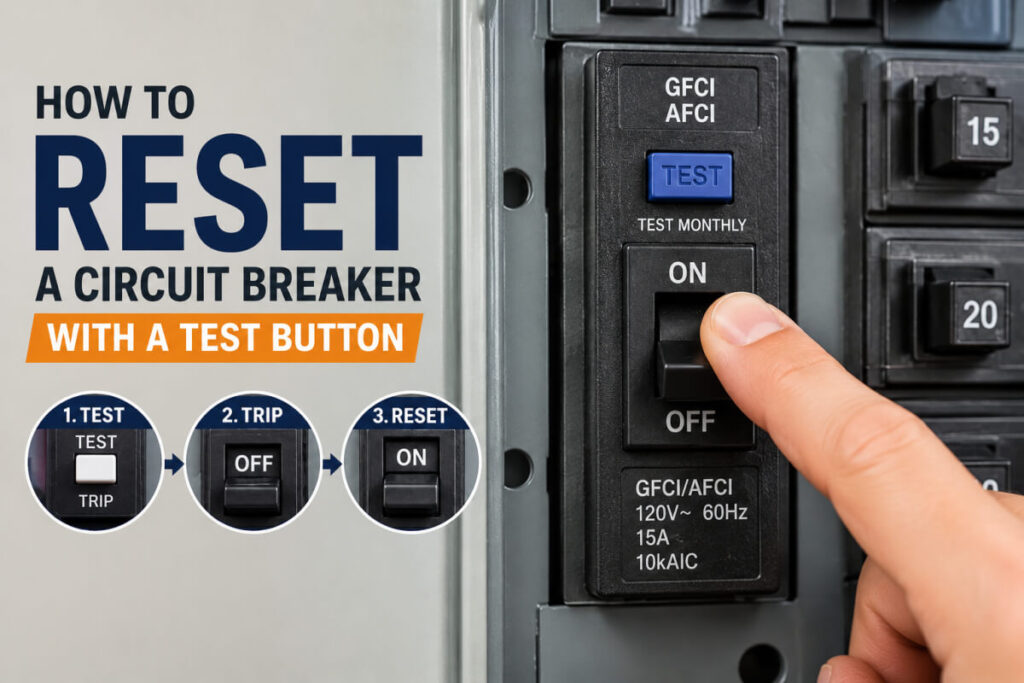
What does the test button do on a breaker? It deliberately simulates a fault condition to confirm the breaker’s protection mechanism is functioning. On a GFCI circuit breaker, pressing the test button simulates a ground fault, tripping the breaker the same way an actual fault would. On an arc fault breaker, the test button triggers the AFCI detection circuitry to verify it responds correctly.
Why a Test Button Breaker Is Different From a Standard Breaker
A standard breaker trips to a middle position and resets by being pushed fully to OFF, then back to ON. A breaker with a test button follows the same sequence, but needs it followed precisely — sometimes also requiring the fault to be cleared or the breaker to cool before it will hold the ON position.
Types of Breakers That Have a Test Button
GFCI Circuit Breakers
Ground fault circuit interrupter breakers protect against shock hazards in wet locations. The test button simulates a ground fault, and the breaker trips to confirm the protection is active.
AFCI (Arc Fault) Breakers
An arc fault breaker test button triggers the arc-detection circuitry. These are required in bedrooms, living rooms, and other areas under modern electrical codes.
Combination AFCI/GFCI Breakers
Some breakers combine both types of protection, with a single test button that exercises both fault detection systems.
15 Amp and 20 Amp Versions
Both 15 amp circuit breakers with test buttons and 20 amp circuit breakers with test buttons follow the same reset procedure, regardless of amperage rating.
How to Reset a Breaker with a Test Button
The correct reset sequence is the key detail most people miss. Unlike a standard breaker where a trip can sometimes be cleared by flipping it straight from the middle to ON, a breaker with a test button typically needs to be pushed past the middle position into a firm OFF before it can be switched to ON.
- Step 1: Unplug any devices on the affected circuit before resetting — if a faulty appliance caused the trip, leaving it connected will trip the breaker again immediately.
- Step 2: Open the panel door — not the dead-front cover, just the outer door as covered in any standard panel access situation.
- Step 3: Push the breaker handle firmly past the middle position to the full OFF position. You should feel a distinct click when it seats.
- Step 4: Wait a few seconds, then push the handle to ON.
- Step 5: If the breaker holds, begin reconnecting devices one at a time to identify any that immediately trip it again.
Why a Circuit Breaker with a Test Button Will Not Reset
A circuit breaker with a test button will not reset for several reasons, and they’re worth working through in order before assuming the breaker itself has failed.
Fault Still Present Downstream
If the cause of the original trip is still connected — a damaged appliance, a wiring short, or a ground fault — the breaker will trip again immediately on reset.
Breaker Not Fully Seated to OFF
The most common reason resetting appears to fail — the handle wasn’t pushed far enough into the OFF position before being switched to ON. The mechanism needs to clear completely.
Overheated Breaker Needs to Cool
A breaker that tripped from sustained overload may need several minutes to cool before its thermal mechanism will allow a reset, even with no load attached.
Failed Breaker
Breakers that have tripped many times can weaken internally. A breaker that won’t stay on even with no load suggests the breaker itself may need replacing.
Breaker Won’t Stay On After Reset
A breaker that flips to ON but immediately trips back is one of the most frustrating fault patterns. The causes range from a simple overloaded circuit to a failing breaker, the same kind of diagnosis worth applying whenever a breaker trips on its own repeatedly without an obvious overload.
- Too many devices on one circuit pulling more current than the breaker’s rating
- A damaged wire or appliance causing a sustained short or ground fault
- A breaker that has internally weakened from years of cycling
- A loose wire connection at the breaker terminal generating excess heat
Common Mistakes to Avoid
- Pressing the test button when trying to reset — test trips the breaker, it doesn’t restore power
- Flipping the breaker from the middle position directly to ON without first seating it in OFF
- Resetting the breaker without unplugging devices on the circuit first
- Repeatedly resetting a breaker that won’t hold instead of diagnosing the underlying fault
- Assuming a test-button breaker that won’t reset has failed before checking for an active fault
When to Call a Licensed Electrician
You should contact a professional if:
- The circuit breaker with test button will not reset even with all devices unplugged
- The breaker resets but immediately trips before any load is connected
- You smell burning or see any discoloration near the panel or breaker
- Multiple breakers are tripping, suggesting a larger electrical issue
- You’re replacing a tripped test-button breaker and need to confirm the correct replacement type, since AFCI and GFCI breakers aren’t interchangeable with standard breaker swaps
Frequently Asked Questions
What Does the Test Button on a Circuit Breaker Do?
It deliberately trips the breaker to simulate a fault and verify the protection circuit is active and working. It is not a reset button — pressing it will cut power, not restore it.
How Do I Reset a Breaker with a Test Button?
Push the handle firmly to full OFF first — past the tripped middle position — then switch it to ON. If it won’t hold, disconnect devices on the circuit and check for a persistent fault before trying again.
Why Won’t My Breaker with a Test Button Reset?
The most likely causes are a fault condition still connected to the circuit, the handle not being fully seated to OFF before switching to ON, or an overheated breaker that needs time to cool. A breaker that won’t reset with no load attached may have failed internally.
Is It Safe to Keep Resetting a Tripped Breaker?
Resetting once is safe when you’ve confirmed no obvious overload. Resetting repeatedly without finding the cause is not — it can stress the breaker’s mechanism and mask a wiring fault that needs diagnosis.
Need Reliable Breakers for Your Panel?
Dvolt manufactures MCBs, RCCBs, and switch disconnectors built for consistent performance and dependable fault protection in residential and commercial electrical panels.
Contact Our Team Browse Circuit BreakersFinal Thoughts
Resetting a circuit breaker with a test button comes down to one key detail: you must push the handle all the way to OFF before switching back to ON — the same fundamental step that applies to resetting any tripped breaker, just more critical on test-button types because the mechanism requires a complete reset stroke. If the breaker holds after resetting, reconnect devices one at a time to isolate any that immediately trip it again. If it won’t hold at all, the fault is still present or the breaker itself needs replacing.
A test-button breaker tripping when faults occur is it doing its job. The issue is only when it won’t reset after following the correct procedure, which points to something downstream worth investigating before calling an electrician.