How to Find the Doorbell Transformer Location, Which Breaker Controls It, and How to Turn Off Doorbell Power Safely
If you can’t find the doorbell circuit breaker in your panel, you’re not alone — most panels don’t have one labeled “doorbell” at all. That’s because the doorbell transformer, which is the only part of a doorbell system that actually connects to a breaker, is usually tapped into an existing lighting or outlet circuit rather than getting its own dedicated slot.
To find the doorbell breaker, you first need to find the transformer. Once you locate the transformer, you can trace the 120V wiring feeding it back to the panel and test breakers until the right one cuts power. This guide covers exactly where to look for a doorbell transformer location, what it looks like, how to identify the breaker, and how to turn off power to the doorbell safely.
Why There’s No “Doorbell” Breaker in Your Panel
A doorbell system runs on very low voltage — typically 16V AC on the chime side — but it still needs a 120V power source for the transformer that creates that low voltage. Most installers simply splice the transformer’s 120V leads into the nearest convenient circuit — a hallway light, closet outlet, or general branch circuit — and that shared circuit almost never gets relabeled “doorbell” in the panel directory, which is why the doorbell breaker is not labeled.
Where Is the Doorbell Transformer Located?
Where is doorbell transformer? In most homes, the transformer is mounted near the main panel, inside a junction box in the basement or utility room, or close to the front door where the doorbell circuit runs. Here are the most common doorbell transformer locations to check:
Near the Main Electrical Panel
One of the most common doorbell transformer locations — mounted on the panel box itself or on the wall beside it, with its two low-voltage leads running toward the front door.
In the Basement or Utility Room
Often attached to a junction box on a ceiling joist or wall stud near where the doorbell wiring enters the framing.
Inside a Closet or Hallway
Common in homes where the doorbell circuit was tapped into a hall light — the transformer may be inside the junction box for that fixture.
Attic or Crawl Space
Older homes sometimes have the transformer tucked into low-traffic spaces where the original installer ran the wiring.
What Does a Doorbell Transformer Look Like?
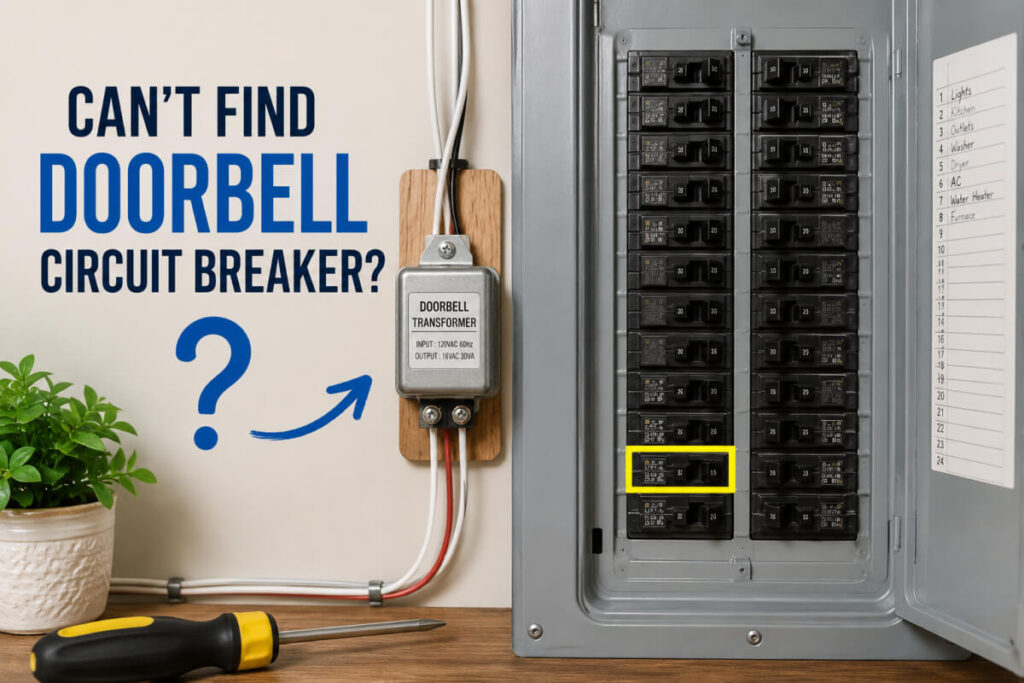
What does doorbell transformer look like? It’s a small metal or plastic box, roughly the size of a deck of cards, usually mounted on a junction box or wall bracket. It has two thicker wires on the primary side connecting to 120V household wiring, and two smaller screw terminals on the secondary side where the thin bell wire attaches.
How to Find the Doorbell Breaker
What You’ll Need
- Flashlight – The transformer is often in a dim corner, closet, or utility space
- Non-Contact Voltage Tester – Confirms which breaker actually cuts power to the transformer
- A Helper (Optional) – Makes it easier to flip breakers at the panel while someone else tests at the transformer
- Marker or Label – To label the breaker once you’ve found it
- Step 1: Locate the doorbell transformer using the common locations listed above. Follow the thin bell wire from the chime unit or push button backward toward its source — it eventually connects to the transformer, which behaves like a small step-down device, converting 120V household current into the low voltage the chime needs.
- Step 2: Once you have the transformer, look at the 120V wiring on its primary side. Note the color and route of those wires; they lead back to the breaker panel or to a junction box that does.
- Step 3: At the panel, test candidate breakers with a voltage tester at the transformer — hallway lighting circuits and basement outlet circuits are the most likely candidates.
- Step 4: Once confirmed, label that breaker in the panel directory so you don’t have to repeat the search.
How to Turn Off Power to a Doorbell
Once you’ve identified the correct doorbell power breaker, turning off power to the doorbell is as simple as flipping that breaker to the off position and verifying the transformer has lost power with a voltage tester. If you can’t locate the breaker at all — for example, because the transformer is inside a sealed junction box doorbell transformer setup with no accessible wiring — the safest option is to turn off the main breaker temporarily while you sort out which circuit it’s on, similar to the approach recommended whenever you’re unsure which circuit controls a component while working inside the panel.
Doorbell Has No Power — Is the Breaker the Problem?
If the doorbell isn’t working and you suspect a power issue rather than a transformer or wiring fault, confirm the circuit is actually live first. A doorbell that has no power or where there’s no power to doorbell often traces back to one of three causes: a tripped breaker feeding the transformer, a blown internal fuse on a newer smart doorbell, or a failed transformer. The doorbell circuit breaker is the logical first check — but if the breaker is on and the doorbell still has no power, the transformer itself may need replacing, which is a straightforward job that doesn’t require replacing the full MCB feeding it.
Common Mistakes to Avoid
- Searching the panel first for a “doorbell” label instead of starting at the transformer
- Assuming a doorbell with no power means a tripped breaker before checking the transformer’s low-voltage output
- Forgetting to label the correct breaker after finding it, making the next search just as frustrating
- Touching the transformer’s primary terminals without first confirming the circuit is de-energized
- Confusing the bell wire terminals with the 120V primary wiring on the transformer body
When to Call a Licensed Electrician
You should contact a professional if:
- You’ve checked every common doorbell transformer location and genuinely cannot find it
- The transformer is inside a sealed or inaccessible junction box that would require opening walls
- The doorbell circuit shares wiring with critical circuits that aren’t safe to interrupt
- A new smart doorbell requires a dedicated circuit rather than a shared tap, which involves adding a new breaker and circuit to the panel
- The transformer shows signs of overheating, burning, or physical damage
Frequently Asked Questions
Where Is the Doorbell Transformer Located?
Most commonly near the main electrical panel, in the basement on a ceiling joist, inside a hallway closet, or tucked into a junction box close to where the doorbell wiring enters the wall framing.
Which Breaker Turns Off the Doorbell?
There’s usually no dedicated doorbell breaker. The transformer shares a circuit with a nearby light or outlet. Find the transformer first, trace the 120V wiring back to the panel, then test candidate breakers with a voltage tester until power drops at the transformer.
Why Is the Doorbell Breaker Not Labeled?
Because the transformer was almost certainly wired into an existing circuit — a hallway light, closet outlet, or general-purpose branch circuit — rather than given a dedicated breaker. The original installer rarely updated the panel directory to reflect that tap.
How Do I Turn Off Power to My Doorbell?
Once you’ve identified the correct breaker, flip it off and verify power is gone with a voltage tester at the transformer’s primary terminals before touching any wiring.
Need Reliable Circuit Protection for Your Home?
Dvolt manufactures MCBs, RCCBs, and switch disconnectors engineered for dependable performance across all residential circuits — from major appliances down to shared circuits feeding small fixtures like doorbell transformers.
Contact Our Team Browse Circuit BreakersFinal Thoughts
The reason you can’t find the doorbell circuit breaker in your panel is almost always the same: the transformer sharing an unlabeled circuit instead of its own dedicated breaker. Start at the chime, trace backward to the transformer, then work from the transformer to the panel — and label that breaker the moment you confirm it so the next person doesn’t have to do this search all over again.
If the transformer itself is the source of the problem — dead, overheated, or outputting the wrong voltage — replacing it is one of the more accessible DIY repairs, as long as you’ve confirmed the circuit feeding it is fully de-energized before touching the primary-side wiring.