Signs of a Failing Breaker, What Partial Failure Looks Like, and When to Replace It
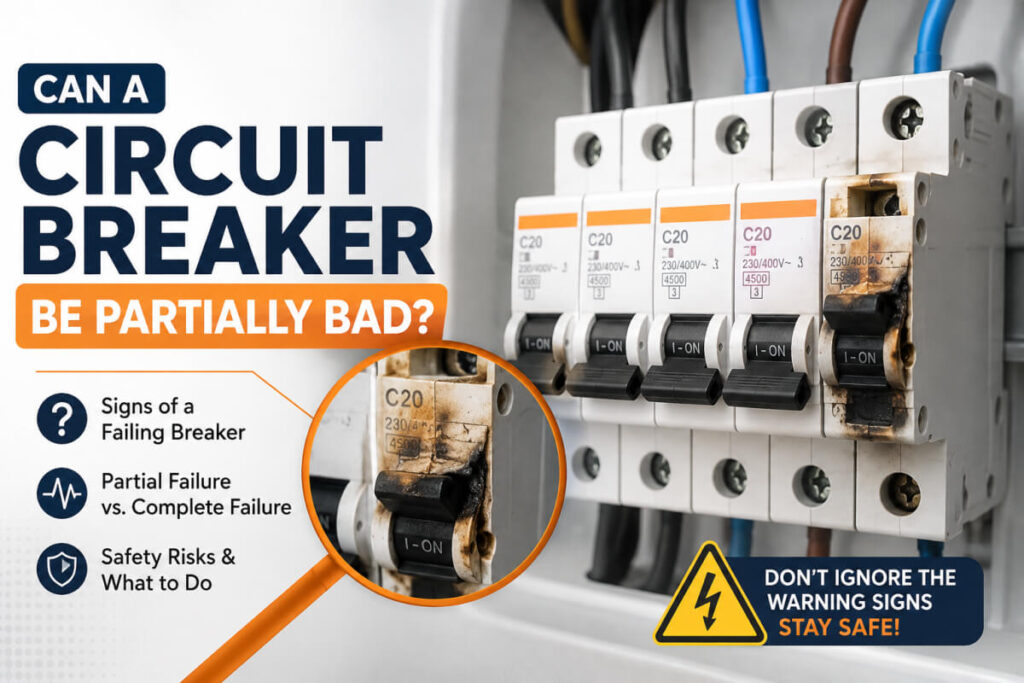
Most people think of a circuit breaker as binary — it works or it doesn’t. But breakers fail in degrees, and a partially bad circuit breaker is often more dangerous than one that has failed completely. A breaker that trips cleanly and stays off is doing its job. A breaker showing inconsistent behavior — a breaker that keeps switching off under light load, power out in one room with no tripped breaker visible, or a handle sitting ON while the circuit is dead — is the kind of fault that causes damage quietly before anything visible goes wrong.
This guide covers what partial breaker failure looks like, the signs a circuit breaker is bad or going bad, how to test a breaker with a multimeter, and when replacement is the only safe option.
What Does “Partially Bad” Mean for a Circuit Breaker?
A circuit breaker can degrade in ways that don’t result in immediate complete failure. These partial failure modes are why “can a part of the breaker go bad?” is exactly the right question to ask.
Weak Trip Mechanism
The bimetallic strip that responds to sustained overload can lose calibration over time. A weakened breaker may allow more current than its rating before tripping — or may not trip at all. The most dangerous failure mode because protective function is gone without any visible sign.
Failed Internal Contact
Internal contacts develop resistance from corrosion, heat cycling, or mechanical wear. The circuit appears to work but runs hotter than it should. Eventually the contact fails open — the breaker looks ON but the circuit is completely dead.
Thermal Fatigue From Repeated Trips
Do circuit breakers wear out? Yes. Thermal fatigue from repeated overload trips is the most common mechanism. Each trip cycles the bimetallic strip; over many cycles, calibration drifts and the breaker becomes unreliable.
Signs of a Bad Circuit Breaker
-
🔁
Breaker keeps switching off under light load If a breaker trips repeatedly with minimal devices on the circuit, the trip mechanism has likely drifted below its rated threshold — a classic sign the breaker is bad and needs replacement.
-
🌡️
Breaker is hot to the touch A panel breaker noticeably hotter than adjacent breakers is generating excess heat from high internal resistance. Normal breakers run warm under load; a genuinely hot breaker is a confirmed fault condition.
-
💡
Power went out in one room but breaker not tripped One of the clearest signs of a partially bad circuit breaker. The handle sits ON, but the circuit is dead. This happens when the internal contact fails open while the trip mechanism hasn’t released — the breaker looks fine from the panel door but is no longer conducting.
-
⚡
Circuit breaker not tripped but no power Same presentation — breaker appears ON, circuit is dead. Always confirm with a multimeter before concluding the fault is in the wiring downstream.
-
🔥
Burning smell or visible discoloration Any burning smell from the panel, or scorch marks or darkening near a breaker handle, means the component has already exceeded safe operating conditions. This requires immediate action, not monitoring.
-
🔒
Breaker won’t reset or stay on A breaker that won’t hold the ON position after a correct reset sequence — fully to OFF, then firmly to ON — either has an active fault on the circuit or has failed internally and cannot self-recover. If the circuit is completely unloaded and the breaker still won’t hold, the breaker itself has failed.
How to Test a Circuit Breaker with a Multimeter
Testing a breaker with a multimeter is the definitive way to distinguish between a bad breaker and a wiring fault further down the circuit.
-
Confirm the breaker is ON and open the panel door. Accessing the panel safely is the first step — make sure the area is dry and you’re working on the interior breakers, not near the main service entrance where the bus bars are always live.
-
Set your multimeter to AC voltage. 120V range for a single-pole breaker; 240V range for a double-pole.
-
Touch the red probe to the breaker’s output terminal (where the black circuit wire connects) and the black probe to the neutral bar. A functioning single-pole breaker reads approximately 120V. A double-pole reads 120V from each output terminal to neutral, and ~240V across both output terminals.
-
If you read 0V with the breaker ON, the internal contact has failed. This is a confirmed bad breaker — it is passing no current despite the switch position. Replace it.
-
If voltage reads correctly but the circuit is still dead, the fault is downstream of the breaker in the wiring or at a device — not the breaker itself.
How Long Do Circuit Breakers Last?
Standard residential breakers are rated for a service life of 30–40 years under normal conditions. But a breaker that has been regularly pushed near its rated limit — or that has tripped from overloads many times — wears faster.
| Usage Pattern | Expected Lifespan | Key Wear Factor |
|---|---|---|
| Lightly loaded, rarely trips | 30–40+ years | Minimal thermal cycling |
| Moderate load, occasional trips | 20–30 years | Normal mechanical wear |
| Near-capacity load, frequent trips | 10–20 years | Bimetallic strip fatigue |
| Repeated overloads / short-circuit events | Less than rated | Accelerated contact pitting and trip mechanism wear |
Faulty Circuit Breaker vs. Wiring Fault: How to Tell
When power is lost and the breaker hasn’t visibly tripped, the fault is in either the breaker or the wiring downstream. The multimeter test above is the definitive tool: correct voltage at the output terminal points downstream; no voltage with the breaker ON points to a failed internal contact.
A bad circuit breaker switch — one where the toggle feels loose, doesn’t click firmly into position, or moves without resistance — is also a mechanical confirmation of failure, independent of the electrical test.
When to Replace a Circuit Breaker
Replace Immediately If:
- The breaker is hot to the touch or shows burn marks or discoloration at the terminal
- A multimeter confirms no output voltage with the breaker in the ON position
- The breaker won’t hold the ON position under no load after a correct reset sequence
- It trips repeatedly under loads well below its rated amperage
- There is a burning smell or visible scorch marks anywhere near the breaker
Replace proactively if the breaker is 25+ years old and showing any marginal behavior — intermittent trips, unexplained power loss on one circuit — before complete failure. If the replacement also involves adding a new circuit or outlet at the same time, that work should always be done by a licensed electrician. For a straight breaker swap on a known-good circuit, a confident DIYer who is comfortable working safely inside a panel can follow the correct procedure — but always understand the full process before opening the panel door.
Frequently Asked Questions
Can a Part of a Breaker Go Bad Without Full Failure?
Yes. Common partial failures include a weakened trip mechanism (no longer trips at rated current), a failed internal contact (appears ON but passes no current), and high-resistance internal connections (conducts but generates excess heat). Each can persist for a significant time before complete failure.
What Does a Tripped Circuit Breaker Look Like?
A tripped breaker handle typically sits between ON and OFF — it has moved from ON but hasn’t reached full OFF. Some panels show a red indicator window when tripped. The handle may also feel less firmly seated than an intentionally ON breaker.
Can a Faulty Circuit Breaker Cause a Fire?
Yes. A breaker that fails to trip under overload allows excess current through the wiring, generating heat in the conductors. Sustained overheating of wire insulation is a leading cause of residential electrical fires. A faulty circuit breaker is not a situation to monitor — it’s one to act on immediately.
How Do I Know If My Breaker Is Bad?
The clearest signs: the breaker is ON but reads no output voltage on a multimeter; it is noticeably hotter than adjacent breakers; it trips repeatedly under light load; or there is visible discoloration or burn marks at the breaker terminal or surrounding panel area.
Do Circuit Breakers Wear Out Over Time?
Yes. The bimetallic trip mechanism fatigues over repeated thermal cycling, and the internal contacts pit from normal arcing each time the breaker trips or is switched. Breakers rated for 30–40 years can wear out earlier under heavy use or frequent overloads.
Need a Reliable Replacement Breaker?
Dvolt manufactures MCBs and switching components built to consistent tolerances for residential and commercial electrical panels.
Contact Our Team Browse Our MCBsFinal Thoughts
A circuit breaker can absolutely be partially bad — and partial failure is often harder to catch than a complete one. A breaker that won’t trip when it should is more dangerous than one that has already failed open and cut the circuit. Knowing the signs of a bad circuit breaker, confirming the fault with a multimeter, and replacing the component before it escalates are the practical steps that keep a manageable fault from becoming a real hazard.
If your breaker is hot, won’t hold, leaves a circuit dead without tripping, or shows any discoloration or burning — that is a confirmed fault. Replace it before relying on that circuit again.