Square D QO Circuit Breaker Series — What It Is, How to Read QO Part Numbers, and How It Compares to HOM
The Square D QO circuit breaker is one of the most recognized residential and light-commercial breaker lines in North America — distinguished by its Visi-Trip indicator, its all-in-one design, and a product line that spans from 15-amp single-pole branch circuit breakers all the way to 200-amp main breakers and tandem configurations. If you’ve inherited a panel, are sourcing a replacement breaker, or are planning a panel upgrade, understanding the QO series — what the part numbers mean, which types exist, and how it compares to Square D’s Homeline line — takes the guesswork out of sourcing the right component.
This guide covers what a QO circuit breaker is, the full range of QO breaker types, how to decode QO part numbers to identify the correct replacement, how QO compares to the Square D HOM (Homeline) series, and what QO panels are compatible with.
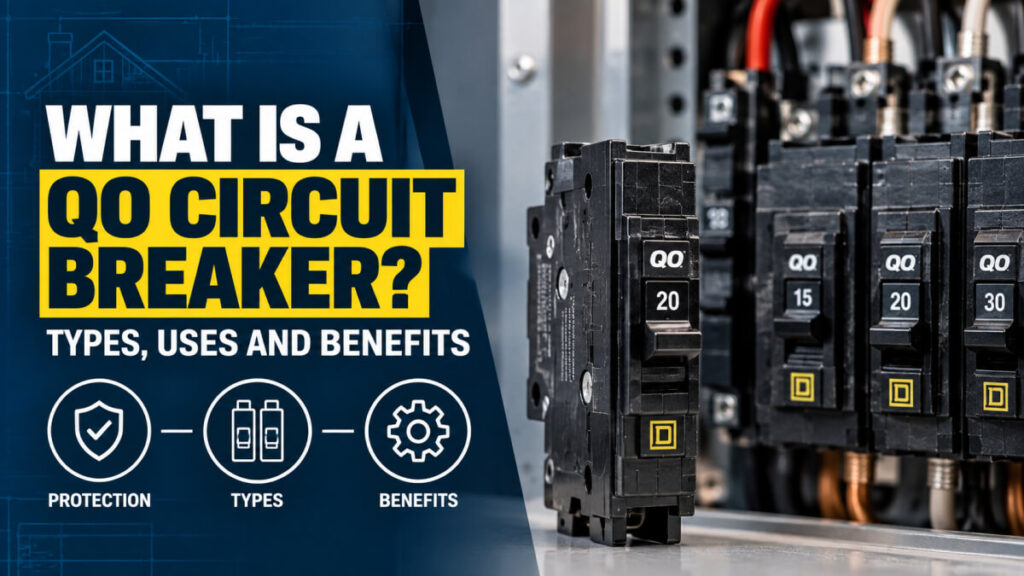
What Is a QO Circuit Breaker?
QO is a product line designation from Square D (a brand of Schneider Electric) for a family of residential and light-commercial circuit breakers designed for use in Square D QO load centers (panels). The “QO” stands for Qwik-Open — a reference to the line’s signature fast-trip thermal-magnetic mechanism, which Square D claims is one of the fastest-tripping residential breakers available.
The defining feature of a QO circuit breaker is the Visi-Trip indicator — a small colored window on the breaker face that turns red when the breaker has tripped, giving a clear visual confirmation of which breaker has tripped without having to test each one individually. This is a QO-exclusive feature not found on Homeline or most other residential breaker lines.
QO breakers are used in QO load centers — Square D panels with the characteristic QO bus bar design. They are not interchangeable with Square D Homeline (HOM) panels or with panels from other manufacturers, even though some physical dimensions may appear similar. The bus bar connection mechanism is different, and using a QO breaker in a non-QO panel (or vice versa) is a code violation and a safety hazard.
QO Circuit Breaker Types: The Full Range
🔵 QO Standard Single-Pole
- 15A to 60A ratings
- 120V branch circuits — lighting, outlets, small appliances
- Part numbers: QO115, QO120, QO130, QO140, QO150, QO160
- Visi-Trip indicator standard on all
🔵 QO Double-Pole (2-Pole)
- 15A to 100A ratings
- 240V circuits — dryers, water heaters, AC units, ranges
- Part numbers: QO2020, QO2030, QO2040, QO2050, QO2060, QO2100
- Both poles trip together — tied handle standard
🛡️ QO GFCI Circuit Breaker
- Single-pole and 2-pole GFCI versions
- For bathrooms, kitchens, garages, outdoor, and wet-area circuits
- Part numbers: QO120GFI, QO120GFICP (pigtail neutral), QO220GFI
- Built-in TEST button; white neutral pigtail wire
🛡️ QO CAFI / AFCI Circuit Breaker
- Arc-fault circuit interrupter — required by NEC for bedrooms and living spaces
- Part numbers: QO115PCAFI, QO120PCAFI, QO115CAFIC
- Plug-on neutral versions available for compatible QO load centers
- TEST button on face; separate neutral conductor required
⚡ QO Tandem (Twin) Breaker
- Two independent single-pole circuits in one slot
- For QO panels with tandem-capable slots only
- Part numbers: QO2020 (not to be confused with 2-pole), QOT1515, QOT2020
- Each handle controls an independent 120V circuit
⚡ QO Main Breaker
- 100A, 125A, 150A, 200A ratings for QO load centers
- Part numbers: QOM1100VH, QOM1200PG, QOM2200VH, QOM2150VH
- Different form factor from branch circuit breakers — not interchangeable with branch positions
- QOM2 series for 200A main service
How to Read QO Circuit Breaker Part Numbers
QO part numbers follow a consistent encoding format that identifies the type, number of poles, and amperage rating. Once you understand the pattern, any QO part number becomes self-explanatory.
QO Part Number Decoder
| QO | Product line prefix — Square D QO series |
| 1 or 2 | Number of poles (1 = single-pole, 2 = double-pole) |
| 15, 20, 30, 40, 50, 60, 100… | Amperage rating |
| GFI / GFICP | GFCI protection; CP = plug-in neutral pigtail |
| PCAFI / CAFI | Arc-fault (AFCI) protection; P = plug-on neutral |
| C | Combined AFCI+GFCI dual protection |
| T (in QOT) | Tandem configuration |
| M1 / M2 (in QOM) | Main breaker; M1 = 1-phase 100–200A, M2 = 2-phase 200A |
| Part Number | Type | Poles | Amps | Application |
|---|---|---|---|---|
| QO115 | Standard | 1 | 15A | Lighting, general outlets |
| QO120 | Standard | 1 | 20A | Kitchen, bath, garage circuits |
| QO2020 | Double-pole | 2 | 20A each pole | Small 240V loads |
| QO2100 | Double-pole | 2 | 100A | Large 240V loads, sub-panel feeder |
| QO120GFICP | GFCI | 1 | 20A | Wet area circuits — plug-in neutral |
| QO115PCAFI | AFCI | 1 | 15A | Bedroom/living room circuits |
| QOT1515 | Tandem | 1+1 | 15A + 15A | Two circuits, one slot |
| QOM2200VH | Main | 2 | 200A | 200A main service breaker |
| QOM2150VH | Main | 2 | 150A | 150A main service breaker |
QO vs. Homeline (HOM): Key Differences
Square D produces two residential breaker lines — QO and Homeline (HOM). They look similar at a glance but are not interchangeable. Understanding the difference prevents a common and costly mistake when sourcing replacements.
QO Series
- Visi-Trip indicator (red window when tripped)
- All-in-one thermomagnetic trip mechanism
- For QO load centers only
- Generally priced higher than HOM
- Available in wider range of specialty types (CAFI, quad, tandem QO)
- Plug-on neutral versions available for compatible QO-PON load centers
- Common in premium residential, commercial applications
Homeline (HOM) Series
- No Visi-Trip indicator
- Separate thermal and magnetic trip elements
- For Homeline load centers only
- Generally priced lower than QO
- GFCI and AFCI versions available
- Plug-on neutral available for compatible HOM-PON panels
- Common in standard new construction residential panels
QO Breaker Compatibility: What Panels Accept QO Breakers?
QO circuit breakers are designed exclusively for Square D QO load centers. The QO series has been produced consistently over many decades, and older QO panels accept the current generation of QO breakers — a significant advantage when servicing older residential installations. QO panels are identified by the “QO” designation on the panel label and by the characteristic bus bar design with individual stab connections for each breaker pole.
Some Square D QO panels also accept tandem breakers in designated tandem-capable slots — these slots are identified on the panel’s circuit directory card. Not all QO panel positions accept tandems; only slots specifically rated for tandem use (typically the lower rows) can accommodate QOT breakers. Running two circuits from one breaker slot requires confirming the panel’s tandem-capable positions first — installing a tandem in a non-tandem slot violates UL listing and is a code deficiency.
For QO panels that have been upgraded to accept plug-on neutral (PON) AFCI and GFCI breakers, the panel will be labeled QO-PON or will have plug-on neutral provisions visible at the neutral bar. Standard QO panels require the pigtail neutral connection on GFCI and AFCI breakers; PON panels allow the breaker to connect directly to the neutral bar without a pigtail wire. Installing a GFCI circuit breaker in a QO panel requires confirming whether a pigtail or plug-on version is needed before purchasing.
Where to Find QO Circuit Breakers
QO circuit breakers are widely available at electrical supply houses, home improvement retailers, and online suppliers. Common QO breakers (QO115, QO120, QO2020, QO2030) are typically stocked items. Specialty types — AFCI, CAFI, high-amperage double-pole, main breakers — are available through electrical distributors or direct from Square D/Schneider Electric. Installing a Square D circuit breaker in a QO panel follows the same seating and torque procedure for all QO types — the breaker clips onto the bus bar stab and the terminal screw is tightened to specification.
Frequently Asked Questions
What Does QO Stand for in Circuit Breakers?
QO stands for Qwik-Open — a reference to the fast-trip thermal-magnetic mechanism Square D uses in the QO series. The name reflects the line’s design priority of fast fault clearing. The QO series is manufactured by Square D, a brand of Schneider Electric, and is one of the most widely used residential breaker lines in North America.
Are QO and Homeline Breakers Interchangeable?
No — QO and Homeline (HOM) breakers are not interchangeable despite both being Square D products. They use different bus bar connection geometries. A QO breaker will not seat correctly in a Homeline panel and vice versa. Always verify the panel type (QO or Homeline) before purchasing a replacement breaker. The panel label identifies the series.
What Is the Difference Between QO and QOT Breakers?
A QO breaker is a standard single-pole or double-pole breaker that occupies one or two panel slots. A QOT (tandem) breaker fits two independent 120V circuits into a single panel slot using two separate breaker handles on one base. QOT breakers can only be installed in tandem-compatible slots in QO panels — check the panel’s circuit directory for tandem-capable positions before purchasing. Adding a new circuit breaker using a tandem requires a tandem-rated slot.
What Is a QOM2 Breaker?
A QOM2 is the main circuit breaker for a Square D QO 200A load center. QOM2 breakers are double-pole main breakers in a larger form factor than standard QO branch circuit breakers — they are not interchangeable with branch circuit positions. The QOM2200VH is the standard 200A residential main; QOM2150VH is the 150A variant. These are used in both new panel installations and as replacements for failed main breakers in existing QO panels.
Can I Replace a QO Breaker Myself?
In most jurisdictions, homeowners can replace a branch circuit breaker in their own panel with the appropriate permit. The QO breaker replacement process — turn off the main, confirm bus bar de-energization with a tester, remove the old breaker, seat the new one on the bus stab, reconnect the wire, torque the terminal — is the same as any residential breaker swap. Changing a circuit breaker safely requires verifying the bus bars are de-energized before touching any terminal — the service entrance cables remain live even with the main breaker off.
Need Circuit Breakers Built to Consistent Tolerances?
Dvolt manufactures MCBs and circuit protection devices for residential and commercial installations — precise ratings, reliable trip characteristics.
Contact Our Team Browse Our ProductsFinal Thoughts
The Square D QO circuit breaker is a mature, widely available product line with a consistent part numbering system that makes identifying the correct replacement straightforward once you understand how to read it. The key distinctions to get right are panel series compatibility (QO vs. HOM), the correct type for the application (standard, GFCI, AFCI, tandem, main), and — for AFCI and GFCI breakers — whether the panel requires a pigtail neutral or accepts a plug-on neutral connection. Match those three parameters to the existing installation and the QO breaker selection is unambiguous.