2 Pole vs 3 Pole Breaker Differences, When a Substitute Works, and How to Choose the Right Breaker for Your Circuit
Standing at the panel with a 3 pole breaker in your hand and a 2 pole circuit to protect is a common situation, especially when the right part is out of stock. So, can I use a 3 pole breaker for a 2 pole circuit? In a few narrow cases, yes. In most homes and small commercial panels, it is the wrong part, and a true 2 pole breaker is the cleaner, safer, and cheaper choice.
The difference comes down to how many hot conductors the breaker switches. A 2 pole breaker protects two ungrounded conductors on a 240V single-phase circuit, such as a water heater or dryer. A 3 pole breaker is built for three-phase equipment, where all three phases must trip together. This guide explains how each breaker works, what really happens when you use two poles of a 3 pole breaker, and how to pick the right device.
What Is the Difference Between a 2 Pole and 3 Pole Breaker?
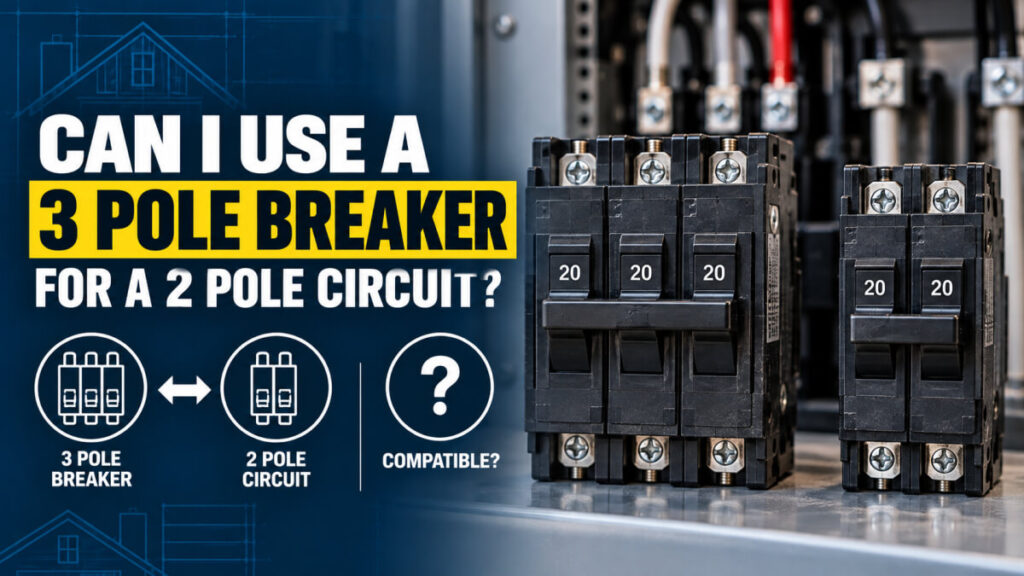
A 2 pole breaker (also called a double pole breaker) is two trip mechanisms joined by a common handle. It takes up two adjacent slots and connects to both legs of a 120/240V single-phase supply, so a fault on either hot conductor opens both. Our guide on how to wire a double pole circuit breaker covers the terminals, wire colors, and bus seating in detail.
A 3 pole breaker adds a third pole and a third bus connection. It spans three slots and is designed for three-phase power, where motors, compressors, and pumps need every phase interrupted at once. If one phase stays live, a three-phase motor can single-phase, overheat, and burn out.
| Feature | 2 Pole Breaker | 3 Pole Breaker |
|---|---|---|
| Hot conductors switched | Two | Three |
| Panel slots used | Two | Three |
| Typical system | 120/240V single-phase | 208V or 480V three-phase |
| Common loads | Dryer, water heater, range, AC | Three-phase motors, compressors, pumps |
| Trip action | Common trip, both poles | Common trip, all three poles |
Can You Use a 3 Pole Breaker for a 2 Pole Circuit?
Electrically, a 3 pole breaker can protect a two-conductor 240V circuit if only two poles carry the load and the third pole stays unused. That does not make it a good substitute, and in many installations it is not permitted. Four conditions must all be true before it is acceptable:
- The breaker is listed for that panel. Breakers are tested as a system with a specific panel. NEC 110.3(B) requires equipment to be installed according to its listing and labeling, so a 3 pole breaker that is not listed for your panel brand and series is a violation, even if it snaps on.
- You use two adjacent poles only. In a single-phase panel, the slots alternate between L1 and L2. Adjacent poles sit on opposite legs and give 240V, while poles 1 and 3 share a leg and give zero volts.
- The voltage and interrupting ratings fit. The breaker must be rated for the circuit voltage, and its kAIC rating must meet the available fault current at the panel.
- The amp rating matches the wire. Choose the breaker for the conductor, not for the one sitting on your shelf.
Single-Phase Panel Bus: 3 Pole Breaker Pole Combinations
Slot 1 ... L1 --+
Slot 2 ... L2 --+--> 3 POLE BREAKER (poles 1, 2, 3)
Slot 3 ... L1 --+

Pole 1 + Pole 2 = 240V   (opposite legs, usable)
Pole 2 + Pole 3 = 240V   (opposite legs, usable)
Pole 1 + Pole 3 =   0V   (same leg, never use)

Unused pole = leave empty, no conductor attached
If any of those four points is uncertain, stop and use a 2 pole breaker.
Problems With Using a 3 Pole Breaker for a 2 Pole Circuit
🔵 Wasted Panel Space
A 3 pole circuit breaker occupies three slots where two would do. In a crowded panel, that one slot can decide between adding a circuit and buying a subpanel.
🔵 Higher Cost for an Idle Pole
A 3 pole circuit breaker costs more than a 2 pole circuit breaker of the same amperage, and the extra pole does nothing for your circuit.
🔵 Voltage Differences in Three-Phase Panels
In a 208Y/120V commercial panel, any two phases give 208V, not 240V. A 240V resistive heater on 208V delivers only about 75 percent of its rated output, because power drops with the square of voltage.
🔵 An Unused Pole Invites Mistakes
An empty third lug is easy to misuse later. Someone may land a conductor there or assume the breaker feeds a three-phase load.
Can You Use a 2 Pole Breaker for a 3 Pole Circuit?
How to Choose the Right Breaker for the Circuit
- Count the ungrounded conductors. Two hot wires call for a 2 pole breaker, and three hot wires call for a 3 pole breaker. Neutral and ground conductors never land on the breaker.
- Confirm voltage and phase. Read the panel label and measure between conductors. Single-phase 240V panels and three-phase 208V panels are built differently, so know which one you have.
- Match the amps to the wire. Use the circuit breaker size calculation to find the load, then check the conductor. A 30 amp breaker needs 10 AWG copper, while 12 AWG stops at 20 amps. If a circuit keeps tripping, resist the urge to fit a bigger breaker, because installing a larger circuit breaker than the wire allows is how overheated cable starts.
- Check panel compatibility. Match brand, series, and type to the panel. The steps for changing a circuit breaker safely show how to confirm the right part before you buy.
- Shut off power and verify. Before touching any breaker, follow the safe method for opening the circuit breaker box, then confirm the bus bars are dead with a tester.
- Install and test. Seat the breaker fully, torque the terminals to the label value, and confirm voltage at the load.
When a 3 Pole Breaker Is the Right Choice
Use a 3 pole breaker when the load is truly three-phase: industrial motors, three-phase HVAC compressors, pumps, and feeders to three-phase subpanels. At higher currents, a 3 pole MCCB (moulded case circuit breaker) adds adjustable trip settings and higher breaking capacity than a standard branch breaker. For two-wire 240V loads such as water heaters, dryers, and ranges, the 2 pole breaker is the correct part.
Frequently Asked Questions
Can I Use a 3 Pole Breaker for a 2 Pole Circuit?
Sometimes, but it is rarely the best choice. It works only if the breaker is listed for the panel, two adjacent poles are used, the ratings fit, and the third pole stays unused. A 2 pole breaker is simpler, cheaper, and cleaner.
What Is the Difference Between a 2 Pole and 3 Pole Breaker?
A 2 pole breaker switches two hot conductors for single-phase 240V circuits. A 3 pole breaker switches three hot conductors for three-phase equipment.
Will a 3 Pole Breaker Fit in a Residential Panel?
Some will clip in physically, but fitting is not the same as being allowed. Only breakers listed for that panel may be installed, so check the panel label.
Can the Unused Pole on a 3 Pole Breaker Feed a Second Circuit?
No. All three poles share a common trip and are meant for one circuit. Never split a 3 pole breaker between separate circuits.
Need the Right Pole Configuration for Your Project?
Dvolt supplies MCBs and MCCBs for residential, commercial, and industrial circuits. Share your voltage, phase, and current, and our team will help you match the correct breaker.
Contact Our Team Browse Our ProductsFinal Thoughts
Pole count should follow the circuit, not the contents of your toolbox. Use a 2 pole breaker on a two-conductor 240V circuit and a 3 pole breaker on a three-phase load. Using a 3 pole breaker for a 2 pole circuit works only when it is listed for the panel, the ratings fit, and two adjacent poles are used, but the wasted slot and higher cost make it a poor trade. When in doubt, buy the correct breaker and have a licensed electrician confirm the panel.