When Upsizing a Circuit Breaker Is Safe, When It’s a Code Violation, and What the Wire Always Decides
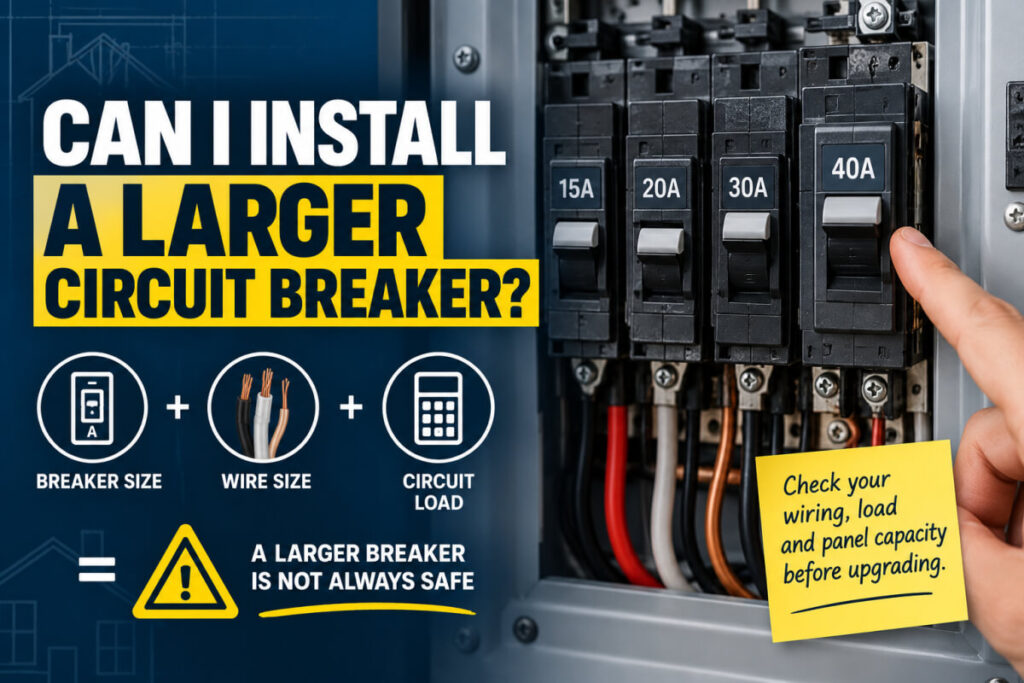
A circuit breaker that keeps tripping is annoying, and the instinct to simply install a larger one is understandable. But the answer to whether you can install a larger circuit breaker depends entirely on one thing: the ampacity of the wire already in the circuit. The breaker doesn’t protect you — it protects the wire. When the breaker is sized correctly for the wire, the wire never overheats. When the breaker is oversized relative to the wire, the wire becomes a fire hazard that the breaker will never respond to.
This guide covers when installing a larger circuit breaker is legitimate and safe, when it’s a code violation regardless of how it’s done, how to determine what your wire can actually handle, and what the correct solution is when a breaker keeps tripping for real reasons.
Can You Install a Larger Circuit Breaker?
Yes — but only if the wire in the circuit is rated for the higher amperage. The NEC (National Electrical Code) is explicit: the overcurrent protection device (the breaker) must not exceed the ampacity of the smallest conductor in the circuit. This is the rule that determines whether upsizing is a legitimate upgrade or a dangerous shortcut.
✅ Installing a Larger Breaker Is Safe When:
- The existing wire is rated for the higher amperage (confirmed by wire gauge)
- The original breaker was undersized relative to the wire — an installation error
- You are replacing the breaker AND upgrading the wire to the correct gauge simultaneously
- The panel has available capacity for the upgraded circuit load
- The installation is inspected and permitted where required by local code
🚫 Installing a Larger Breaker Is a Violation When:
- The existing wire cannot handle the higher current (most common scenario)
- The breaker is being upsized to stop nuisance tripping without fixing the underlying cause
- Wire gauge is unknown and not verified before the swap
- The circuit is already at the maximum the wire allows (e.g., 20A breaker on 12 AWG)
- No permit is obtained in a jurisdiction that requires one for panel work
Wire Gauge Is the Deciding Factor
Every wire gauge has a maximum current rating defined by the NEC. The breaker on that circuit must be equal to or less than that rating. This is non-negotiable — it’s the fundamental principle behind circuit protection. Before touching the breaker, the first step is always to identify the wire gauge in the circuit.
| Wire Gauge (AWG) | Max Ampacity (Copper) | Max Breaker Size | Typical Application |
|---|---|---|---|
| 14 AWG | 15A | 15A | Lighting, general outlets |
| 12 AWG | 20A | 20A | Kitchen, bath, garage circuits |
| 10 AWG | 30A | 30A | Dryers, water heaters, AC units |
| 8 AWG | 40A | 40A | Electric ranges, large HVAC |
| 6 AWG | 55A | 50–60A | EV chargers, sub-panel feeders |
| 4 AWG | 70A | 60–70A | Large sub-panels, high-draw loads |
If the circuit has 12 AWG wire, the maximum breaker is 20A — full stop. A 30A breaker on 12 AWG wire means the wire can carry 30A of current before the breaker notices anything is wrong. At that point, the wire insulation is already overheating. The reason the circuit was tripping in the first place needs to be addressed — not bypassed by upsizing the protection.
Why the Breaker Is Tripping — and Why Upsizing Is Rarely the Fix
A breaker trips because it detected a condition the circuit wasn’t designed to handle. Upsizing the breaker raises the threshold at which that detection happens — it doesn’t fix the condition. Before considering any breaker change, the actual cause of the tripping should be diagnosed.
-
Overloaded circuit. Too many devices drawing current on a single circuit. The solution is redistributing loads to different circuits or adding a new dedicated circuit — not upsizing the breaker on the existing wire. A proper circuit breaker size calculation for the actual connected load determines whether the circuit itself needs to be upgraded.
-
Short circuit. A hot wire and a neutral wire are in direct contact somewhere in the circuit — at an outlet, junction box, or in the wiring run. A short circuit draws thousands of amps instantly and will trip any correctly sized breaker immediately. Upsizing the breaker doesn’t help — it just means the fault draws even more current before the breaker trips, causing more damage.
-
Ground fault. Hot wire contacting a grounded surface. Same destructive current draw as a short circuit. A GFCI breaker provides the appropriate protection — not a higher-rated standard breaker.
-
The breaker itself is failing. A breaker that trips at lower current than its rating, or trips intermittently under normal load, may be worn or internally damaged. Identifying whether a circuit breaker is genuinely bad is the correct diagnostic step — replacing it with the same size breaker fixes the problem without creating a wiring hazard.
-
Continuous load exceeding 80% of breaker capacity. A 20A breaker on a circuit with a 17A continuous load is at 85% of rated capacity — the NEC limit for continuous loads is 80%. The NEC-compliant solution is a 25A breaker with 10 AWG wire, not forcing a 12 AWG circuit to carry more current.
When Installing a Larger Breaker Is the Correct Upgrade
There are legitimate scenarios where a larger breaker is exactly the right answer — provided the wire supports it.
The Original Breaker Was Undersized
Installation errors happen. A circuit that was wired with 10 AWG but has a 20A breaker installed has room for a 30A breaker without any wire change. Confirming the wire gauge, then installing the correctly matched breaker, is a legitimate fix. This is common when previous owners made conservative or incorrect sizing choices.
You Are Upgrading Both Breaker and Wire Together
The cleanest approach to upsizing any circuit is replacing both the breaker and the wire run simultaneously. This gives you a properly matched circuit at the new rating. Upgrading a circuit breaker as part of a full circuit upgrade — new wire, new breaker, verified load calculation — is code-compliant and safe.
Adding a Dedicated Circuit for a High-Draw Load
When a new appliance or load requires more current than the existing circuit can support, the correct solution is usually adding a new dedicated circuit with the appropriate wire and breaker for that specific load — rather than attempting to upgrade an existing shared circuit that serves other outlets or devices.
Before You Install a Larger Breaker: The Verification Checklist
Confirm All of These Before Any Breaker Upsize:
- Wire gauge verified — physically inspect the wire at the panel or an outlet box, not estimated from the existing breaker size
- Wire ampacity equals or exceeds the new breaker rating — the table above gives the NEC ampacity by gauge
- All outlets and devices on the circuit are rated for the new current level — standard 15A outlets must not be on a 20A+ circuit without 20A-rated receptacles
- Panel has capacity for the additional load — total connected load must stay within panel rating
- Permit obtained if required — panel work requires a permit in most jurisdictions; check with your local AHJ
- Breaker brand compatible with panel — not all breakers are interchangeable; use the panel manufacturer’s listed breakers or UL-listed equivalents
Standard Circuit Breaker Sizes and What Controls Each One
Understanding the standard circuit breaker sizes and the wire gauge each requires helps confirm whether a given upgrade is even possible without rewiring the circuit.
| Upgrade Scenario | Existing Wire | Can Upsize To | Wire Change Needed? |
|---|---|---|---|
| 15A → 20A breaker | 14 AWG | No — 14 AWG max is 15A | Yes — must replace with 12 AWG |
| 15A → 20A breaker | 12 AWG | Yes — 12 AWG supports 20A | No — wire is already rated |
| 20A → 30A breaker | 12 AWG | No — 12 AWG max is 20A | Yes — must replace with 10 AWG |
| 20A → 30A breaker | 10 AWG | Yes — 10 AWG supports 30A | No — wire is already rated |
| 30A → 40A breaker | 10 AWG | No — 10 AWG max is 30A | Yes — must replace with 8 AWG |
Frequently Asked Questions
Can I Replace a 15 Amp Breaker with a 20 Amp Breaker?
Only if the wire in the circuit is 12 AWG. Most 15A circuits use 14 AWG wire, which is only rated for 15A — installing a 20A breaker on 14 AWG wire is a code violation and a fire hazard. Check the wire gauge first. If it’s 12 AWG, the swap is safe. If it’s 14 AWG, the wire must be replaced along with the breaker.
Can I Replace a 20 Amp Breaker with a 30 Amp Breaker?
Only if the wire is 10 AWG. Most 20A circuits use 12 AWG wire, rated for 20A maximum. A 30A breaker on 12 AWG wire means the wire can carry 30A before the breaker trips — significantly above the wire’s safe operating limit. If the wire is 10 AWG, a 30A breaker is the correct match.
Why Does My Breaker Keep Tripping If the Wire Is Rated High Enough?
If the wire supports a larger breaker but the circuit keeps tripping, the cause is in the load or the breaker itself — not the wire rating. A circuit breaker that trips at below its rated current may be internally worn and needs replacement at the same rating, not a larger one.
Do I Need a Permit to Install a Larger Circuit Breaker?
In most jurisdictions, any work inside the electrical panel requires a permit and inspection. The requirement varies by locality — check with your local authority having jurisdiction (AHJ). Unpermitted panel work can create issues with home insurance and resale, and inspection failures can require the work to be redone.
Can I Install a Larger Breaker Myself?
In many jurisdictions, homeowners are permitted to do their own electrical work on their primary residence with the appropriate permit. However, panel work carries the risk of exposure to live bus bars even with the main breaker off — the service entrance cables remain energized. Changing a circuit breaker safely requires following specific de-energization and safety steps before any breaker is touched.
Need Circuit Breakers Built to Consistent Tolerances?
Dvolt manufactures MCBs and circuit protection devices for residential and commercial installations — precise ratings, reliable trip characteristics across the full range of standard sizes.
Contact Our Team Browse Our ProductsFinal Thoughts
Installing a larger circuit breaker is sometimes exactly the right move — and sometimes one of the more dangerous things you can do to a home’s electrical system. The wire gauge decides which one it is. If the wire supports the higher rating, a larger breaker is a legitimate upgrade. If it doesn’t, the wire must be replaced alongside the breaker. And if the breaker is tripping for a real reason — an overloaded circuit, a fault condition, or a failing breaker — upsizing the protection doesn’t fix the problem, it just delays the consequences.