Circuit Breaker Sizing Calculation — The NEC Formula, Standard Sizes, and How to Size a Breaker for Any Load
Choosing the wrong circuit breaker size is one of the most common electrical planning mistakes — and one of the more consequential ones. An undersized breaker trips under normal load; an oversized breaker fails to protect the wiring it’s supposed to guard. Knowing how to calculate circuit breaker size correctly means applying the right formula to the load data you have, cross-referencing NEC standard circuit breaker sizes, and understanding the rule that governs continuous versus non-continuous loads.
This guide covers the complete circuit breaker sizing calculation process — from reading amperage data on equipment labels, to applying the 125% NEC multiplier, to matching your calculated value to a standard breaker size available in the field.
The Core Circuit Breaker Size Formula
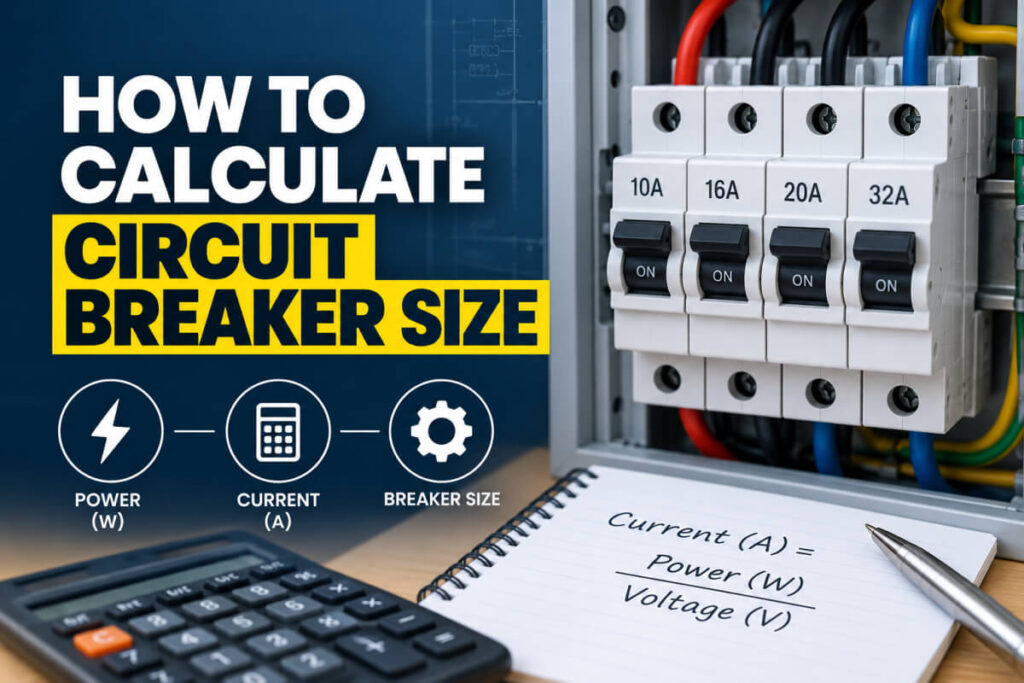
The fundamental circuit breaker sizing calculation follows a straightforward two-step formula defined by the National Electrical Code:
Where Load Amperage is the full-load current draw of the circuit in amps. For resistive loads (heaters, ovens, water heaters), this is the rated wattage divided by voltage. For motors and compressors, use the Full Load Amperage (FLA) from the equipment nameplate — not a calculated estimate.
How to Calculate Circuit Breaker Size: Step-by-Step
-
Find the load amperage (FLA or rated current). Check the equipment nameplate for FLA (Full Load Amps) or MCA (Minimum Circuit Ampacity). For purely resistive loads without a nameplate, divide watts by voltage: Amps = Watts ÷ Volts. A 4,800W 240V water heater draws 4,800 ÷ 240 = 20A.
-
Determine whether the load is continuous or non-continuous. Continuous loads run for 3 or more hours — HVAC systems, water heaters, EV chargers, lighting circuits. Non-continuous loads (a toaster, a drill) run briefly. Most circuits you are sizing for a permanent installation are continuous.
-
Apply the 125% multiplier for continuous loads. Multiply the load amperage by 1.25. A 20A continuous load requires a breaker sized for at least 25A (20 × 1.25 = 25). A 16A continuous load requires at least 20A (16 × 1.25 = 20).
-
Round up to the next standard NEC circuit breaker size. If your calculation produces a number that falls between standard sizes, always round up — never down. The NEC prohibits sizing a breaker below the calculated minimum. Standard sizes: 15, 20, 25, 30, 35, 40, 50, 60, 70, 80, 90, 100A and above.
-
Verify the wire gauge matches the breaker size. A breaker only protects wiring if the wire ampacity matches or exceeds the breaker rating. A 20A breaker requires 12 AWG minimum; a 30A breaker requires 10 AWG minimum. Mismatched wire and breaker sizing is a fire hazard — confirm both before installation.
NEC Standard Circuit Breaker Sizes
After running the calculation, the result must be matched to a standard breaker size. The NEC defines these standard sizes — breakers are manufactured to these ratings, and your calculated minimum must be met or exceeded by the next available standard size.
14 AWG wire minimum
12 AWG wire minimum
10 AWG wire minimum
8 AWG wire minimum
6 AWG wire minimum
4 AWG wire minimum
Circuit Breaker Sizing by Load Type
Different load types follow slightly different sizing conventions. Understanding these distinctions is the key to accurate circuit breaker computation across different applications.
Breaker Size for Motors (FLA Method)
Motors require a different approach because they draw significantly higher current at startup (LRA — Locked Rotor Amps) than during normal operation. For motor circuit protection, the NEC uses the FLA (Full Load Amps) from the motor nameplate as the basis, then allows a specific multiplier for the overcurrent protection device. A pool pump motor rated 1.5 HP drawing 10A FLA is protected by a breaker sized at 10A × 2.5 (standard NEC motor multiplier) = 25A maximum. The breaker size for motor applications uses the NEC 430.52 table, which allows up to 250% of FLA for inverse-time breakers. The correct breaker type for motor circuits matters as much as the rating — standard thermal-magnetic breakers are the common choice.
Breaker Size for Air Conditioners
Circuit breaker sizing for air conditioners uses the MCA (Minimum Circuit Ampacity) and MOCP (Maximum Overcurrent Protection) values from the unit’s data plate — these are the legally required values the manufacturer has calculated to NEC standards. Apply the 125% rule to the MCA value if no MOCP is stated. A 3-ton residential unit with a 20A MCA requires a minimum 25A breaker (20 × 1.25). Most residential central AC systems require a 30A to 50A circuit breaker depending on system size.
Breaker Size for Electric Ovens and Ranges
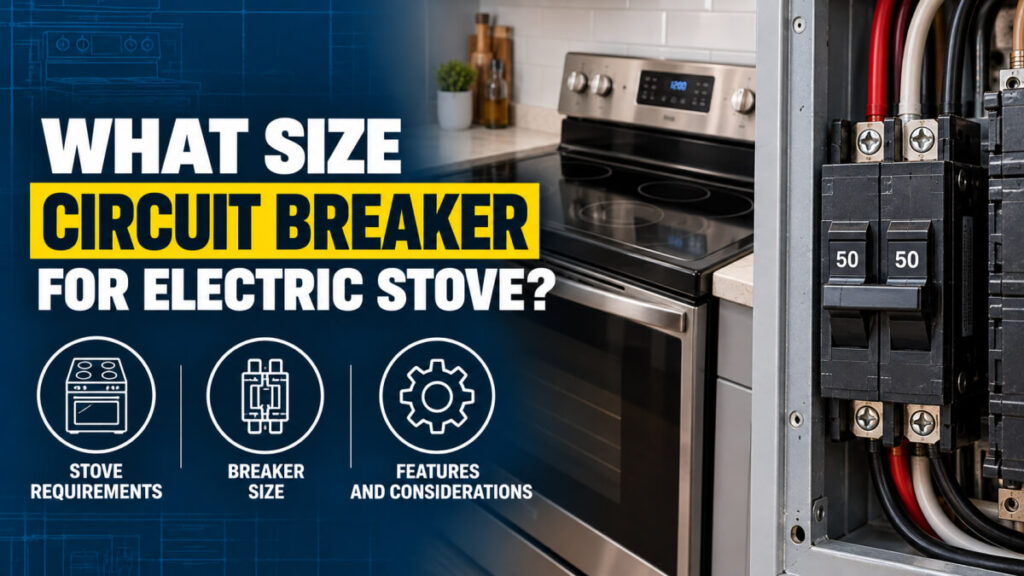
Electric ranges and ovens are large continuous loads. A standard 240V electric range draws between 40A and 50A. The NEC allows a demand factor reduction for household cooking equipment — but for a single range, a 50A circuit breaker is the standard residential installation. Always verify the appliance nameplate for the actual rated amperage before determining the breaker size for oven installations.
Worked Example: Sizing a Breaker for a 4,000W 240V Water Heater
Step 1 — Load amperage: 4,000W ÷ 240V = 16.7A
Step 2 — Continuous load? Yes (water heater runs for extended periods)
Step 3 — Apply 125%: 16.7A × 1.25 = 20.8A
Step 4 — Round up to standard size: 20.8A → next standard size = 25A breaker
Step 5 — Wire size: 25A breaker requires 10 AWG copper minimum
Circuit Breaker Sizing Chart: Common Loads
| Load / Equipment | Typical Draw | Multiplier | Minimum Breaker Size | Wire Gauge |
|---|---|---|---|---|
| General lighting / outlets (15A circuit) | Up to 12A continuous | ×1.25 | 15A | 14 AWG |
| Kitchen small appliances | Up to 16A | ×1.25 | 20A | 12 AWG |
| Electric dryer (240V) | 24A | ×1.25 | 30A | 10 AWG |
| Electric water heater (4,500W) | 18.75A | ×1.25 | 25A | 10 AWG |
| Central AC (3-ton) | 20A MCA | ×1.25 | 30A | 10 AWG |
| Electric range / oven | 40–50A | NEC demand factor | 50A | 6 AWG |
| EV charger (Level 2, 48A) | 48A continuous | ×1.25 | 60A | 6 AWG |
| Pool pump motor (1.5HP) | 10A FLA | ×2.5 (NEC 430.52) | 25A | 12 AWG |
Main Circuit Breaker Sizing
Sizing a main circuit breaker for a residential service follows the same calculation logic but applies to the total connected load of the dwelling. A standard residential main service is 100A or 200A. The 200A service has become the default for new residential construction — it accommodates modern electrical loads including EV chargers, electric HVAC, and high-draw kitchen appliances. When upgrading a circuit breaker from 100A to 200A main service, the calculation must account for total connected load plus diversity factor, typically performed by the utility or a licensed electrician during service upgrade planning.
Common Circuit Breaker Sizing Mistakes
- Using wattage without converting to amps first. Breakers are rated in amps, not watts. Always convert: Amps = Watts ÷ Volts.
- Forgetting the 125% rule for continuous loads. The most common sizing error — a breaker sized exactly at the load amperage will trip under sustained full-load current.
- Rounding down instead of up. If the calculation yields 22A, the correct breaker is 25A, not 20A. Rounding down puts the breaker below the NEC minimum.
- Ignoring wire gauge when sizing up. Upgrading a circuit breaker to a larger size without upgrading the wire creates a condition where the wiring is no longer protected. Wire and breaker must be sized together.
- Using FLA instead of MCA for HVAC. For air conditioning equipment, always use the MCA from the data plate — not a calculated FLA estimate — as the basis for breaker sizing.
Frequently Asked Questions
How Do You Calculate Circuit Breaker Size?
Multiply the load amperage by 1.25 (125%) for continuous loads, then round up to the next standard NEC breaker size. For example, a 16A continuous load requires a minimum 20A breaker (16 × 1.25 = 20). For motors, use the NEC 430.52 table multiplier applied to the FLA from the motor nameplate.
What Size Circuit Breaker Do I Need for a 20-Amp Circuit?
A 20-amp circuit uses a 20A breaker with 12 AWG wire minimum. The 20A circuit can serve a maximum continuous load of 16A (20 × 0.80). If your load exceeds 16A continuous, size up to a 25A or 30A circuit.
How Do I Determine Breaker Size for a Motor?
Use the FLA (Full Load Amps) from the motor nameplate and the NEC 430.52 table. For standard inverse-time circuit breakers, the maximum breaker size is 250% of FLA. A motor drawing 10A FLA can be protected by a breaker up to 25A. Testing the circuit breaker after installation confirms the protection is functioning correctly.
What Is the NEC Rule for Circuit Breaker Sizing?
NEC 210.20(A) requires that continuous loads not exceed 80% of the breaker’s rated ampacity. This translates to the 125% sizing formula: breaker size = load amps × 1.25, rounded up to the next standard size. The breaker must also not exceed the ampacity of the wire it protects.
Can I Use a Bigger Breaker Than Required?
Only if the wire can handle the increased current. A 30A breaker on a circuit with 12 AWG wire (rated for 20A) is a code violation and a fire hazard — the wire will overheat before the breaker trips. The breaker must be sized to protect the wire, not sized up to avoid nuisance tripping. If you need more capacity, check whether the breaker itself is failing before assuming the circuit needs to be upsized.
Need Circuit Breakers Built to Consistent Tolerances?
Dvolt manufactures MCBs and circuit protection devices for residential and commercial installations — precise ratings, reliable trip characteristics.
Contact Our Team Browse Our ProductsFinal Thoughts
Circuit breaker sizing comes down to three things: accurate load data, the NEC 125% continuous load multiplier, and matching the result to a standard breaker size. Get the load amperage from the equipment nameplate rather than estimating, apply the 125% rule for any load that runs more than three hours, and always verify the wire gauge is rated for the breaker you’re installing. The calculation takes minutes and removes any guesswork from one of the most protection-critical decisions in electrical planning.