Electric Stove Breaker Size, Wire Gauge, and Amperage Reference for Ranges, Cooktops, and Wall Ovens
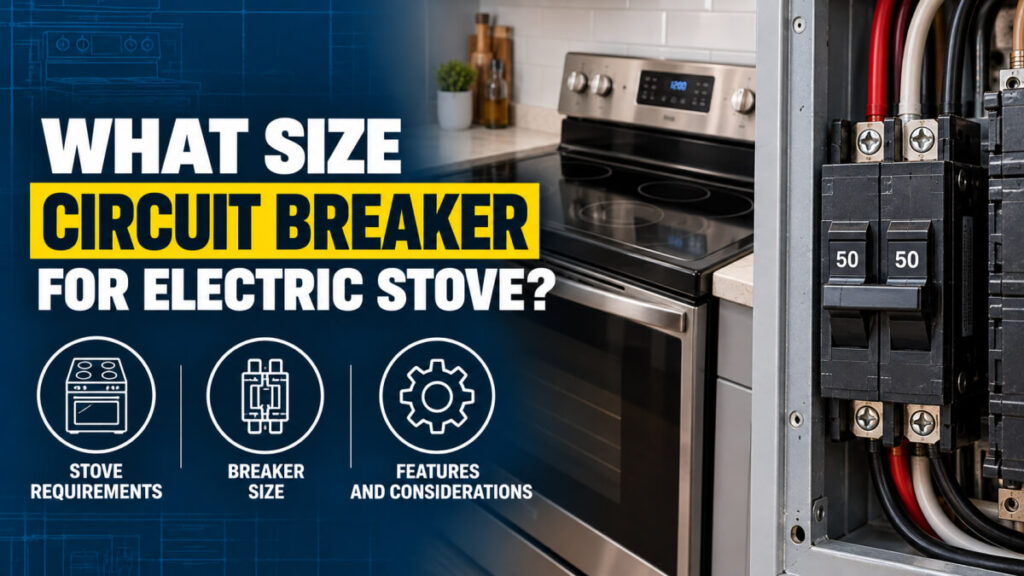
What size breaker for an electric stove? In most homes, the answer is a 50 amp double pole circuit breaker for range circuits, wired with 6 AWG copper wire. That pairing covers the large majority of household ranges and matches the NEMA 14-50 receptacle used on new installations. Smaller cooktops and wall ovens can run on 30 or 40 amp breakers, but the breaker, the wire, and the appliance all have to agree.
Getting it wrong costs you either way. A breaker that is too small trips whenever you preheat the oven with the burners running. Wire that is too thin for the breaker can overheat inside the wall without ever tripping. This guide covers electric stove amps, the right wire size for an electric range, standard NEC breaker sizes, and the mistakes to avoid.
How Many Amps Does an Electric Stove Use?
Amps equal watts divided by volts. A range with a 12,000 watt nameplate on a 240V circuit draws 12,000 ÷ 240 = 50 amps at full load. Electric burner wattage usually runs between 1,200 and 3,000 watts per element, and oven elements add roughly 2,500 to 4,000 watts, so the amperage for electric stove circuits adds up quickly. The same math works for any appliance, and our guide to calculating circuit breaker size shows how to apply it.
NEC Table 220.55 applies a demand factor to household ranges, so a 12 kW range calculates to about 8 kW, or roughly 33 amps. That is why 40 amps is the code minimum for most ranges, and why most manufacturers specify a 50 amp circuit breaker for electric range installations. Use this table as a starting point for electric stove amperage, electric range breaker size, electric cooktop breaker size, and the breaker size for oven circuits.
| Appliance | Typical Amps | Breaker Size | Copper Wire |
|---|---|---|---|
| Full-size electric range | 40 to 50A | 50A double pole | 6 AWG |
| Smaller range (if manual allows) | Up to 40A | 40A double pole | 8 AWG |
| Electric cooktop (30 to 36 in.) | 30 to 40A | 40A double pole | 8 AWG |
| Single wall oven | 20 to 30A | 30A double pole | 10 AWG |
| Double wall oven | 30 to 50A | 40A or 50A double pole | 8 or 6 AWG |
Electric Stove Wire Size: What Gauge Wire for an Electric Stove?
Electric stove wiring size comes down to one rule: the wire must survive the current the breaker allows. Wire ampacity must be equal to or greater than the breaker rating, and the breaker must be equal to or greater than the appliance load. This AWG ampacity table shows copper values at the 60°C rating used for standard NM cable.
| Wire Gauge | Ampacity | Standard Breaker | Typical Stove Use |
|---|---|---|---|
| 12 AWG | 20A | 20A | Not for stoves |
| 10 AWG | 30A | 30A | Single wall oven |
| 8 AWG | 40A | 40A | Cooktop, small range |
| 6 AWG | 55A | 50A | Full-size range |
So the size of wire for electric stove circuits is 6 AWG copper on a 50 amp breaker, and that is the standard wire gauge for range installations. The 6 AWG amp rating is 55 amps, and since no standard 55 amp breaker exists, the 6 AWG ampacity pairs with a 50 amp breaker. The 12 gauge wire max amps is 20, so 12 AWG belongs on lighting and receptacle circuits, not on a range. A 10 AWG conductor tops out at 30 amps, and if you use aluminum, a 50 amp range circuit needs 4 AWG. For a 30 amp wall oven circuit, the wire size rules for a 30 amp circuit breaker explain why 10 AWG is the step down.
New range circuits use a four-conductor cable: two hots, a neutral, and a ground, such as 6/3 with ground. It connects to a NEMA 14-50 receptacle or is hardwired to the range. The code has required separate neutral and ground conductors on new range circuits since 1996.
50A Electric Stove Circuit: Terminal Reference
50A DOUBLE POLE BREAKER --> 6/3 + GROUND CABLE --> NEMA 14-50 OR RANGE

Breaker terminal 1  --  BLACK  --  Hot L1   (X)
Breaker terminal 2  --  RED    --  Hot L2   (Y)
Neutral bar         --  WHITE  --  Neutral  (W)
Ground bar          --  BARE    --  Ground   (G)

L1 to L2 = 240V  |  each hot to neutral = 120V
NEC Standard Circuit Breaker Sizes
Breakers come only in the standard sizes listed in NEC 240.6(A). In the range that matters for stoves, those are 15, 20, 25, 30, 35, 40, 45, 50, and 60 amps. You cannot buy a 55 amp stove breaker, so the breaker size for electric stove circuits follows the lowest limit in the chain: the wire, the receptacle, or the appliance rating.
How to Install a Stove Circuit Breaker
- Read the nameplate and manual. Note the wattage, the amperage, and whether the range uses a receptacle or is hardwired.
- Pick the breaker and wire from the tables. Most full-size ranges take a 50 amp double pole stove circuit breaker and 6 AWG copper.
- Turn off power and verify. Switch off the main breaker and test the bus bars before touching anything.
- Wire the double pole breaker. The black and red conductors connect to the two breaker terminals, the white neutral lands on the neutral bar, and the bare ground goes to the ground bar. Our walkthrough on how to wire a double pole circuit breaker shows each connection.
- Seat the breaker and test. Press it fully onto the bus, restore power, and confirm 240V between the hot terminals at the outlet and 120V from each hot to neutral.
Common Electric Stove Breaker Mistakes
🔵 Installing a 50 Amp Breaker on 8 AWG Wire
8 AWG copper cable is rated for 40 amps. A 50 amp breaker lets that wire carry more current than it can handle, and the insulation can overheat before the breaker responds.
🔵 Swapping in a Bigger Breaker to Stop Trips
Nuisance tripping is a symptom, not a sizing problem. Before you consider installing a larger circuit breaker, check the connections, the appliance, and the wire rating, because oversizing removes the protection the wire depends on.
🔵 Using Two Single-Pole Breakers
A 240V range needs a 2 pole breaker so both hot legs shut off together. Two separate single-pole breakers can leave one leg live after the other trips.
🔵 Mixing Up 10-50 and 14-50 Receptacles
Older three-prong NEMA 10-50 receptacles do not provide a separate ground. New installations use the four-prong NEMA 14-50, rated for 50 amps.
Frequently Asked Questions
What Size Breaker for Electric Stove Circuits?
Most electric stoves need a 50 amp double pole breaker with 6 AWG copper wire. Some smaller ranges and cooktops allow 40 amps with 8 AWG wire, but only when the manufacturer’s installation manual permits it.
How Many Amps Does an Electric Stove Use?
Full-size electric ranges typically draw 40 to 50 amps at full load, depending on wattage. Cooktops draw 30 to 40 amps, and single wall ovens draw 20 to 30 amps.
What Size Breaker for 6 AWG Wire and 10 Gauge Wire?
6 AWG copper pairs with a 50 amp breaker for a range circuit. What size breaker for 10 gauge wire? Thirty amps, the limit set by NEC 240.4(D).
Can I Use 12 Gauge Wire for an Electric Stove?
No. The max amps on 12 gauge wire is 20, far below what a stove draws. Using it on a stove circuit risks overheating and fire.
Why Does My Stove Breaker Keep Tripping?
Common causes include a loose terminal, a failing heating element, a worn breaker, or an overloaded circuit. Our guide on what causes a circuit breaker to keep tripping walks through the checks, and a licensed electrician should handle anything inside the panel.
Looking for Dependable Breakers for 240V Appliance Circuits?
Dvolt manufactures MCBs and MCCBs for residential and commercial installations, with consistent ratings and reliable trip performance. Tell us your load, voltage, and application, and our team will help you specify the right breaker.
Contact Our Team Browse Our ProductsFinal Thoughts
When people ask what size breaker for stove circuits, the answer comes down to three matches: the breaker to the appliance, the wire to the breaker, and the receptacle to both. For most full-size ranges, that means a 50 amp double pole breaker, 6 AWG copper, and a NEMA 14-50 outlet or hardwired connection. Smaller cooktops and wall ovens step down to 40 or 30 amps.