Double Pole Breaker Wiring Diagram, Step-by-Step Connection Guide, and Wire Gauge Reference for 240V Circuits
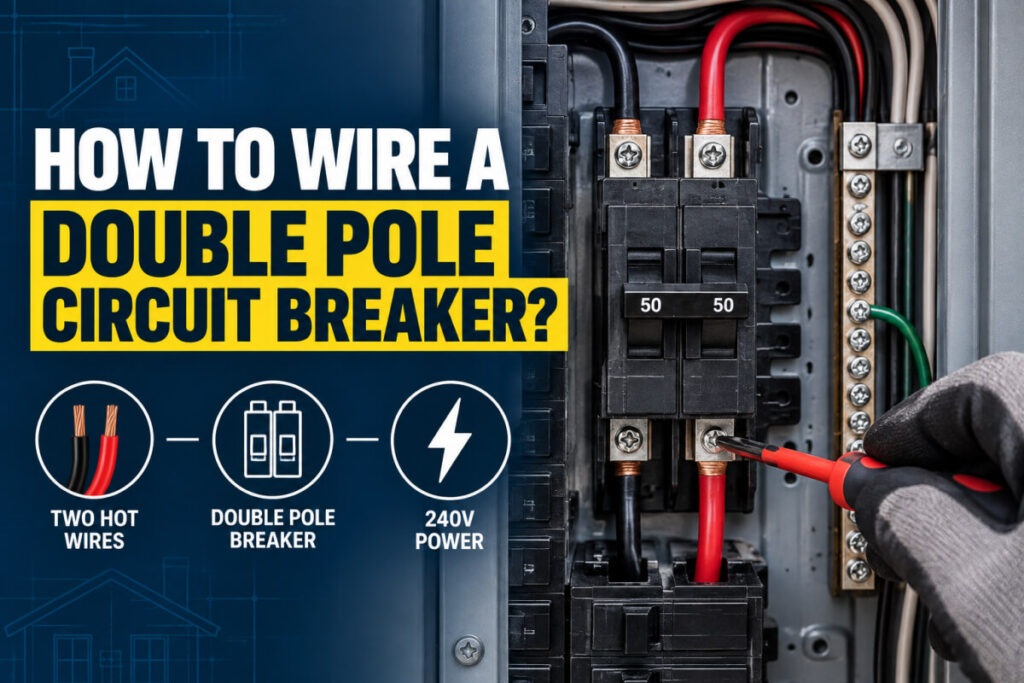
Wiring a double pole circuit breaker is the starting point for any 240V circuit — a dryer, an electric range, a central AC unit, a sub-panel feeder, or a 50-amp EV charger. Unlike a single-pole breaker that switches one hot leg, a double pole breaker occupies two slots in the panel and simultaneously switches both hot legs of a 240V supply. The wiring process is straightforward once you understand the terminal layout, the role of each wire color, and why both hot legs must be connected to the breaker rather than one.
This guide walks through the complete double pole circuit breaker wiring process — the wire connections at the breaker terminals, the correct wire gauge for the breaker size, how to seat the breaker in the panel, and the safety steps that apply to any panel work.
What Is a Double Pole Breaker and When Do You Need One?
A double pole circuit breaker is a single breaker unit with two internal trip mechanisms linked together — when either pole trips, both switch off simultaneously. It occupies two adjacent slots on the hot bus bar in the panel, connecting to both the L1 and L2 legs of a 240V supply. The two hot legs together provide 240V between them, while each leg is 120V relative to neutral.
| Load / Application | Typical Breaker Size | Wire Gauge (Copper) | Voltage |
|---|---|---|---|
| Electric dryer | 30A double pole | 10 AWG | 240V |
| Electric water heater | 30A double pole | 10 AWG | 240V |
| Central AC unit (3-ton) | 30–40A double pole | 10–8 AWG | 240V |
| Electric range / oven | 50A double pole | 6 AWG | 240V/120V |
| EV charger (Level 2, 48A) | 60A double pole | 6 AWG | 240V |
| Sub-panel feeder (100A) | 100A double pole | 1/0 AWG aluminum | 240V |
| Welder (220V outlet) | 50A double pole | 6 AWG | 240V |
Wire Colors in a Double Pole Breaker Circuit
Understanding the role of each wire before connecting anything prevents reversed polarity and ensures the circuit is protected correctly. A standard 240V circuit uses a cable with specific conductor colors for each function.
Connects to breaker terminal 1
Connects to breaker terminal 2
Connects to neutral bar (not the breaker)
Connects to ground bar
For a pure 240V circuit (water heater, AC unit, some welders), only black, red, and bare ground are needed — no neutral conductor is required because the load runs entirely on 240V. For a 120/240V circuit (electric range, dryer with 120V components), all four conductors are used. This is the key distinction that determines whether to use a 10-2 cable (two conductors plus ground) or a 10-3 cable (three conductors plus ground) — and it directly affects how the neutral bar is used.
How to Wire a Double Pole Circuit Breaker: Step-by-Step
-
Turn off the main breaker and verify power is off. Push the main breaker to the OFF position. Use a non-contact voltage tester on the hot bus bars inside the panel — not on the service entrance cables — to confirm the bus bars are de-energized before touching anything. Opening the circuit breaker box safely means verifying bus bar voltage is absent, not just assuming the main is off.
-
Choose the correct wire gauge for the breaker size. The wire must be rated at or above the breaker’s amperage. A 30A double pole breaker requires 10 AWG minimum; a 50A requires 6 AWG; a 60A requires 6 AWG or 4 AWG depending on load type. Running the correct circuit breaker size calculation confirms both the breaker rating and the required wire gauge before any cable is pulled.
-
Route the cable into the panel and strip the conductors. Remove the panel knockout that provides entry for the new circuit cable. Route the cable through the entry point with at least 6 inches of conductor length inside the panel for working room. Strip approximately ¾ inch of insulation from each conductor end — enough to make a solid connection at the terminal screw without excessive bare wire exposed.
-
Connect the hot conductors to the double pole breaker terminals. Loosen the two terminal screws on the breaker — one on each pole. Insert the black wire into one terminal and the red wire (or re-identified white wire if using 10-2 cable) into the other terminal. Tighten each terminal screw firmly — most residential breaker terminals require 35–40 in-lb torque. A loose hot connection at the breaker terminal is a primary cause of arcing and overheating.
-
Connect the neutral conductor to the neutral bar (if present). If the circuit requires a neutral (dryer, range), connect the white conductor to an open terminal on the neutral bar — not to the breaker itself. Double pole breakers do not have a neutral terminal; neutral conductors always land on the neutral bar.
-
Connect the ground conductor to the ground bar. Connect the bare copper or green ground conductor to an open terminal on the ground bar. In a main panel, the neutral bar and ground bar are typically bonded together. In a sub-panel, they must be kept separate — a critical distinction when wiring a sub-panel from a double pole feeder breaker.
-
Seat the double pole breaker on the bus bar. Align the breaker’s rear clips with the hot bus bar stabs. Press firmly — first the clip side, then press the front of the breaker until it snaps fully onto the bus. Both poles must be fully seated. A partially seated double pole breaker creates a high-resistance connection that generates heat. Confirm both breaker screws (if panel-secured) are tightened to the panel manufacturer’s specification.
-
Restore the panel cover and test the circuit. Replace the breaker cover plate with all blank breaker covers in place. Restore the main breaker to ON. Switch the new double pole breaker to ON and verify voltage at the load end of the circuit with a voltmeter — you should read approximately 240V between the two hot conductors and 120V between each hot conductor and neutral (if neutral is present).
Double Pole Breaker Wiring Diagram
  PANEL BUS BAR                 DOUBLE POLE BREAKER
  ─────────────                 ──────────────────────────────
  L1 (Hot Bus 1) ──────────────► Terminal 1 ──► BLACK wire ──► Load L1
  L2 (Hot Bus 2) ──────────────► Terminal 2 ──► RED wire   ──► Load L2

  NEUTRAL BAR    ──────────────────────────────► WHITE wire ──► Load Neutral
                                                              (only if neutral required)

  GROUND BAR     ──────────────────────────────► BARE/GREEN ──► Load Ground

  NOTE: 10-2 cable (no red) — re-identify white wire as hot (black tape)
        Connect re-identified white to Terminal 2 in place of red
Common Double Pole Breaker Wiring Mistakes
Connecting Neutral to the Breaker Terminal
A double pole breaker has two hot terminals only. The neutral wire goes to the neutral bar — never to a breaker terminal. Connecting neutral to a breaker terminal puts it on the switched side of the circuit and creates a shock hazard at the load.
Using 10-2 Wire Without Re-Identifying the White Conductor
When using two-conductor cable (black and white only), the white wire serves as the second hot leg. Without marking it with black or red tape at both ends, anyone working on the circuit later may treat it as neutral — a serious shock risk. This re-identification is a NEC requirement, not a suggestion.
Wrong Wire Gauge for the Breaker Size
Pairing a 30A double pole breaker with 12 AWG wire (rated for 20A) is one of the more dangerous wiring errors — the wire can carry 30A before the breaker responds. Always match the wire gauge to the breaker rating before pulling any cable.
Mixing Ground and Neutral in a Sub-Panel
In a sub-panel, the neutral bar and ground bar must remain separated. Bonding them in a sub-panel creates multiple neutral return paths and can cause stray current on ground conductors. Only the main panel has the neutral-ground bond. When installing a new circuit from a double pole feeder, verify the sub-panel configuration before landing the neutral.
Partially Seating the Breaker on the Bus Bar
A double pole breaker that isn’t fully snapped onto both bus bar stabs creates a resistive connection that generates heat at the bus contact. Always press firmly until the breaker snaps fully into position and confirm it cannot be rocked off the stab with hand pressure. If a breaker is hard to seat, check whether the panel type matches — not all breakers are compatible with all panels, and forcing an incompatible breaker onto a bus bar can damage both.
Frequently Asked Questions
How Do You Wire a Double Pole Breaker?
Connect the black wire to one terminal of the double pole breaker and the red wire (or re-identified white wire) to the other terminal. Connect the neutral to the neutral bar and the ground to the ground bar — not to the breaker itself. Seat the breaker firmly on both bus bar stabs and torque the terminal screws to the manufacturer’s specification.
What Wire Do I Need for a 30 Amp Double Pole Breaker?
A 30A double pole breaker requires 10 AWG wire minimum. Use 10-3 cable (black, red, white, ground) for circuits that need a neutral — like a dryer. Use 10-2 cable (black, white, ground) for pure 240V loads with no neutral, but re-identify the white wire as a hot conductor with black tape at both ends.
Does a Double Pole Breaker Need a Neutral Wire?
Not always. Pure 240V loads (water heaters, AC units, well pumps) run on two hot legs only and do not require a neutral conductor. Loads that also use 120V (dryers with 120V motors, electric ranges with 120V controls and lighting) require a neutral. The load’s wiring diagram or data plate specifies whether neutral is required.
How to Wire a Double Pole Breaker with 10-2 Wire?
With 10-2 cable (black and white conductors plus ground), the black wire connects to one breaker terminal and the white wire connects to the other — serving as the second hot leg. The white wire must be re-identified as a hot conductor by wrapping its exposed ends with black or red electrical tape at the panel and at the load device. The bare ground connects to the ground bar.
Can a 2-Pole Breaker Be Used for Two Separate 120V Circuits?
A standard double pole breaker is not designed for two independent 120V circuits — it’s an overcurrent device for a single 240V circuit. Multi-wire branch circuits (sharing a neutral between two 120V hot legs) require a handle-tied double pole breaker to ensure both poles trip together. This is a specific NEC requirement and not the same as a standard 240V installation. Running two circuits from one breaker has specific NEC requirements that must be met.
Need Double Pole Breakers Built to Consistent Tolerances?
Dvolt manufactures MCBs and circuit protection devices for residential and commercial 240V installations — precise ratings, reliable trip characteristics.
Contact Our Team Browse Our ProductsFinal Thoughts
Wiring a double pole circuit breaker correctly comes down to four things: correct wire gauge for the breaker size, black and red hot conductors on the breaker terminals, neutral on the neutral bar (not the breaker), and the breaker fully seated on both bus bar stabs. The re-identification of white wire as hot when using two-conductor cable is the step most often skipped — and the one that creates the most serious downstream hazard. Get those fundamentals right and a double pole breaker installation is one of the more straightforward panel additions a competent DIYer can handle with the appropriate permit.