Single-Pole vs. Double-Pole Contactors — What the Difference Is and Which One Your Air Conditioner Uses
If you’re replacing an AC contactor and trying to match the correct part, one of the first specs you’ll encounter is the number of poles. Most residential air conditioners use a two-pole contactor. Some older units use a single-pole. Getting this wrong means either the replacement won’t function correctly or — using a single-pole where a two-pole is required — a genuine safety hazard. Understanding the difference and how to confirm what your system uses takes the guesswork out of sourcing a replacement.
This guide covers how many poles an AC unit contactor has, the difference between single-pole and double-pole designs, why most residential systems use two-pole contactors, and how to confirm the correct specification before ordering.
What Is a Contactor Pole?
A contactor pole is one switching contact — one set of input (line) and output (load) terminals that open and close together when the contactor coil energizes. A two-pole contactor has two sets of contacts switching simultaneously. In a 240V AC system — which residential air conditioners run on — the supply consists of two 120V legs (L1 and L2). Each leg needs to be switched to safely interrupt and restore power to the compressor and condenser fan motor. Understanding how L1 and L2 connect to the T1 and T2 load terminals makes clear why a two-pole design is the correct standard — both legs must switch together for the load to be fully de-energized when the system is off.
How Many Poles Does a Residential AC Contactor Have?
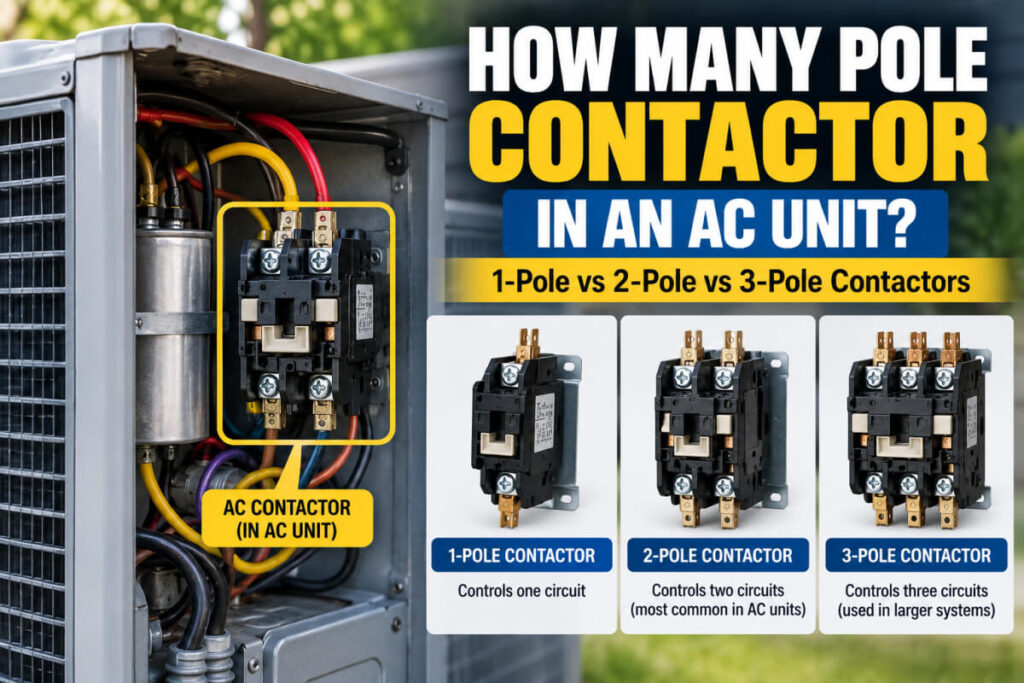
Most residential air conditioners use a 2-pole (double-pole) contactor. This is the industry standard for single-phase 240V residential cooling systems. The two-pole design switches both legs of the 240V supply simultaneously when the thermostat calls for cooling, and opens both legs when the cycle ends.
Some older residential systems used a single-pole contactor. Older installations — particularly pre-1990s — sometimes used a single-pole that only switched one leg. This left the other leg energized through the compressor at all times, even when the system wasn’t running. This is no longer used in new installations and is a code violation in most jurisdictions.
Commercial and three-phase systems use three-pole contactors. Three-phase HVAC systems require a three-pole contactor — one for each phase of the supply. Common in commercial equipment, not in residential applications.
Single-Pole vs. Double-Pole Contactor: Key Differences
⚠️ Single-Pole (1-Pole)
- Switches one leg of 240V supply (L1 only)
- Leaves L2 permanently connected through compressor
- Found in some older residential equipment
- Not code-compliant for new installations
- Not a safe replacement where two-pole is required
✅ Double-Pole (2-Pole)
- Switches both legs of 240V supply (L1 and L2) simultaneously
- Fully de-energizes compressor and fan when open
- Standard for all modern residential AC units
- Correct replacement for any system originally using two-pole
- Code-compliant in all jurisdictions for 240V residential loads
Why Residential AC Units Use 2-Pole Contactors
The two-pole design completely de-energizes the load when the contactor opens. Both L1 and L2 are disconnected simultaneously, leaving no energized conductors at the compressor or fan terminals while the system is off. When both poles switch together, the contact sets also wear evenly — each carries the same current through the same switching cycles. The two-pole design additionally gives a technician clear visual confirmation that both supply legs are interrupted when the contactor is open — important when working inside the condenser cabinet after confirming power is off at the panel.
Contactor Amperage Ratings for Residential AC Units
The amperage rating of the contactor must equal or exceed the load it controls. Match the rating on the original part, not an estimate based on system size alone.
| System Size | Typical Amperage | Coil Voltage | Poles |
|---|---|---|---|
| 1.5 – 3 ton residential | 30A | 24V AC | 2-pole |
| 3.5 – 5 ton residential | 40A | 24V AC | 2-pole |
| Commercial / 3-phase | 30A – 60A+ | 24V or 120V AC | 3-pole |
Using an undersized contactor accelerates contact pitting and shortens service life. If an incorrect spec is the reason the contactor isn’t engaging or is failing prematurely, confirming the correct amperage before replacement is essential. If you’re also evaluating the cost to replace an AC contactor, having specs confirmed upfront avoids the cost of a wrong-part return.
How to Confirm the Correct Contactor Specification
Before Ordering a Replacement Contactor, Confirm:
- Pole count — shown on the contactor label (1P, 2P, or 3P)
- Coil voltage — almost always 24V AC on residential units
- Amperage rating — 30A or 40A for most residential systems
- Operating voltage — 240V for residential single-phase systems
- Original part number — if readable, the fastest way to guarantee a matched replacement
Compressor Contactor vs. Condenser Contactor
In a standard residential system, both the compressor and condenser fan motor are controlled by the same contactor — both loads run off the same two poles, with the compressor on one set of load terminals and the fan on the other. Some larger or premium systems have separate contactors for each, but this is the exception in standard residential equipment.
Frequently Asked Questions
How Many Poles Does an AC Contactor Have?
Most residential AC units use a 2-pole (double-pole) contactor that switches both legs of the 240V supply simultaneously. This is the code-compliant standard for modern residential air conditioning systems.
What Is a 2-Pole Contactor?
A 2-pole contactor has two sets of switching contacts that open and close together. In a residential AC application, it connects and disconnects both legs of the 240V supply (L1 and L2) to the compressor and condenser fan motor when the thermostat calls for cooling.
Can I Replace a 2-Pole AC Contactor with a 1-Pole?
No. A single-pole replacement leaves one leg of the 240V supply permanently energized through the compressor — a safety hazard and a code violation in modern installations. Always match the original pole count.
What Amperage AC Contactor Do I Need?
Match the amperage rating on the original contactor. Most residential systems use 30A or 40A. If the original label is unreadable, check the condenser unit’s data plate for MCA and maximum overcurrent ratings.
What Coil Voltage Does a Residential AC Contactor Use?
Almost universally 24V AC on residential units. The coil receives its signal from the thermostat low-voltage circuit. A coil voltage mismatch will prevent the contactor from engaging correctly — confirm before ordering.
Need the Right Contactor for Your System?
Dvolt manufactures contactors and switching components built to consistent tolerances for residential and commercial HVAC applications.
Contact Our Team Browse Our ProductsFinal Thoughts
Most residential air conditioners use a 2-pole contactor — the design that switches both legs of the 240V supply simultaneously and fully de-energizes the load when the system is off. Confirming the pole count, coil voltage, and amperage rating from the original part before ordering a replacement takes minutes and prevents a hazardous installation or wasted return trip. When the specs match, a contactor replacement is one of the more straightforward HVAC component swaps a competent DIYer can handle.