Breaker Box Covers, Panels, and Decorative Options — What the NEC Allows and What It Prohibits
A circuit breaker box in the middle of a living room wall, a basement hallway, or a finished bedroom is one of those practical realities homeowners work around — and almost always want to conceal. The good news is that covering a circuit breaker box is allowed under the National Electrical Code, with one firm condition: the panel must remain accessible at all times. What you can put over it, how it can attach, and what counts as “accessible” are the details that separate a compliant installation from a code violation.
This guide covers what the NEC says about covering electrical panels, the cover options that comply with those rules, decorative and furniture-based solutions that let you hide a breaker box without violating access requirements, and what you should never do — regardless of how the installation looks.
Can You Cover a Circuit Breaker Box? What the NEC Says
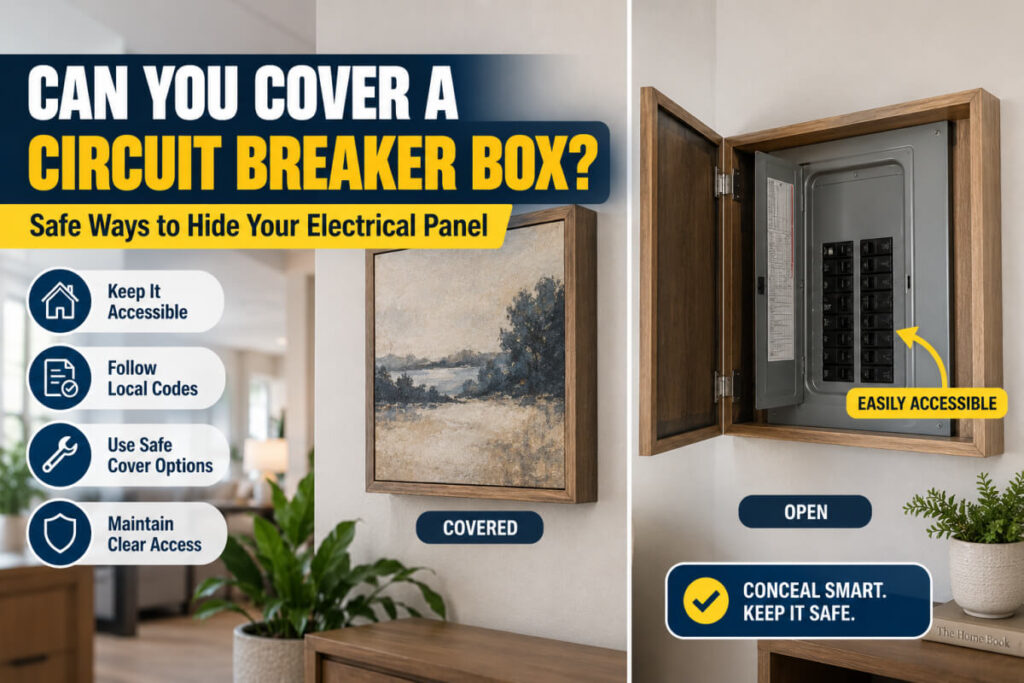
Yes — you can cover a circuit breaker box, but the panel must remain accessible. NEC Article 110.26 requires that electrical panels have unobstructed working space in front of them and that the panel itself can be opened and serviced without removing any permanent structure. A framed painting on a hinge, a sliding cabinet door, or a magnetic electrical panel cover all satisfy this requirement because they can be moved in seconds. A built-in bookcase screwed directly to the wall over the panel does not — even if the books can technically be removed.
The distinction the code enforces is between a cover (something that conceals but does not obstruct) and a permanent obstruction (something that requires tools or structural modification to remove). The former is permitted; the latter is a violation.
Compliant Ways to Cover a Breaker Box
The options that satisfy both the concealment goal and the NEC access requirement fall into a few categories. Each has different installation demands and aesthetic outcomes.
🖼️ Hinged Picture Frames
- Frame is mounted to the wall on a hinge beside the panel
- Swings open like a cabinet door for full panel access
- Most popular DIY solution — no modifications to the panel
- Available as ready-made units or custom-built from standard frames
🧲 Magnetic Electrical Panel Covers
- Decorative panel mounted with rare-earth magnets to the metal panel box
- Lifts off instantly — no hardware, no hinges
- Artwork to cover electrical panel is the most common magnetic option
- Works on any standard steel panel box without modification
🚪 Sliding Panel Doors
- Cabinet-style door that slides to one side on a track
- Works well when floor space in front of panel is limited
- Can be designed to match surrounding cabinetry or built-ins
- Track hardware must allow full door removal for panel servicing
🎨 Decorative Circuit Breaker Cover Panels
- Purpose-built decorative circuit breaker cover designed to fit standard panel boxes
- Some use the existing breaker cover plate as a mounting surface
- Available in multiple finishes and sizes for residential panels
- Maintains full access to the breaker cover plate underneath
How to Hide a Breaker Box: What Works in Each Room
The approach that works best depends on where the panel is located. A panel in a utility room has different concealment priorities than one in a living room or finished bedroom.
Living Room and Finished Spaces
Magnetic electrical panel covers with printed artwork are the least invasive option — they attach without drilling, remove completely in a second, and can be replaced with different designs. A hinged frame with a canvas print is the next most popular choice for living spaces. Both give the appearance of a decorative element rather than a utility box. When choosing artwork to cover an electrical panel, size matters — the cover should overlap the panel trim on all sides without being so large it looks like it’s hiding something.
Basement and Utility Areas
In utility spaces, a simple load center cover or blank breaker cover plate replacement is often enough — the NEC-required cover panel (the metal door that covers the breaker bank) must be in place at all times when the panel is not being serviced. Beyond that, a curtain hung on a tension rod is the simplest concealment solution that guarantees compliant access. Before opening the circuit breaker box for service, anything in front of it must be fully movable.
Hallways and Tight Spaces
In narrow hallways, maintaining the 36-inch working depth in front of the panel is often the harder constraint than the cover itself. A sliding cover that moves completely to one side — rather than swinging out into the hallway — is the practical solution. The panel needs enough clear space in front of it to stand and work safely.
What You Can Never Do — Regardless of Aesthetics
Several cover approaches look reasonable but create genuine code violations or safety hazards. These apply regardless of how the finished installation looks or how infrequently the panel is accessed.
| What Not to Do | Why It’s a Problem |
|---|---|
| Build permanent cabinetry flush to the wall over the panel | Permanent structure over the panel requires tool removal — not code-compliant |
| Paint over the breaker box or breaker cover plate | Can make the panel door stick; paint in breaker mechanisms is a fire risk |
| Remove the breaker cover plate and leave wiring exposed | NEC requires the dead front (breaker cover) to be in place whenever panel is not being actively serviced |
| Place furniture permanently blocking the working clearance zone | Violates NEC 110.26 even if the panel door itself is reachable |
| Screw a decorative panel directly over the breaker cover plate | Makes the breaker cover non-removable — another violation of NEC access requirements |
| Install a lockable cover without leaving a key at the panel | Delays emergency access — a code concern in rental and commercial properties |
Breaker Box Cover Components You May Need to Replace
Before adding a decorative layer over the panel, it’s worth checking that the panel’s own components are in good condition. These are the parts that make up the panel’s built-in cover system.
Standard Residential Panel Cover Components
- Breaker cover plate / dead front — the inner metal panel that covers the live bus bars and wiring, with cutouts for each breaker handle. Must be present whenever the panel is not being actively serviced.
- Blank breaker cover — small filler pieces that cover unused breaker slots in the cover plate. Missing blanks leave openings to live bus bars — replace them before adding any decorative outer cover.
- Load center cover / panel box cover — the outer door of the panel enclosure, which may have a trim ring or collar. Some panels use circuit breaker collar or trim pieces to finish the edge where the panel meets drywall.
- Breaker panel cover screws — the screws that hold the dead front in place. These must be present and secure. Missing screws are a code deficiency.
- Circuit breaker retainer clip — holds individual breakers in position on the bus. Not a cover component, but a missing retainer clip allows a breaker to shift — relevant to confirm before installing a tight-fitting decorative cover.
If any of these internal components are missing, damaged, or non-original (a Cutler Hammer panel cover replacement, a Square D cover panel swap, or a panel that has been modified over the years), address those first. A decorative outer cover cannot substitute for a missing dead front or missing blank breaker covers. Checking the condition of the breakers inside the panel at the same time is sensible — a panel you’re already accessing for a cover upgrade is worth a quick inspection.
Frequently Asked Questions
Can You Cover an Electrical Panel?
Yes, provided the cover allows unrestricted access to the panel without removing any permanent structure. Hinged frames, magnetic covers, and sliding doors all comply. Permanent built-in cabinetry over the panel does not.
What Is the Best Way to Hide a Breaker Box?
Magnetic electrical panel covers with artwork are the least invasive option — they require no drilling, no hardware, and lift off instantly. Hinged picture frames are the most popular DIY option for finished living spaces. Both satisfy NEC access requirements.
Can You Put a Bookcase in Front of a Circuit Breaker Box?
A freestanding bookcase that can be moved without tools is generally compliant, provided it doesn’t reduce the 36-inch working depth in front of the panel below the NEC minimum. A built-in bookcase fastened to the wall is not compliant — it constitutes a permanent obstruction.
Do I Need a Permit to Cover a Breaker Box?
A decorative non-structural cover (magnetic panel cover, hinged frame) does not typically require a permit. Adding cabinetry or built-in elements that require structural attachment near the panel may require a permit depending on local codes. Check with your local authority having jurisdiction (AHJ) for built-in work.
What Is a Breaker Box Cover Plate?
The breaker cover plate (also called the dead front) is the inner metal panel that covers the live bus bars and wiring inside the electrical panel, with cutouts for each individual breaker handle. It must always be in place when the panel is not being actively serviced. It is separate from — and required underneath — any decorative outer cover.
Need Circuit Protection Components or Replacement Parts?
Dvolt supplies MCBs and panel components for residential and commercial electrical systems — built to consistent tolerances for reliable protection.
Contact Our Team Browse Our ProductsFinal Thoughts
Covering a circuit breaker box is straightforward as long as the cover allows unrestricted access — the NEC’s requirement is access, not visibility. Magnetic panel covers and hinged frames are the most popular compliant solutions for finished living spaces. The one rule that never has an exception: the breaker cover plate must always be in place, and nothing permanently fixed to the wall should require tools to remove before the panel can be opened. Get those two things right and you have considerable freedom in how the panel looks within your space.