How to Check for a Blown Fuse in a Circuit Breaker Box — Visual Signs, Multimeter Testing, and When to Replace
A blown fuse in a circuit breaker box can look like a lot of things — a dead circuit, flickering lights, appliances that simply won’t power on, or windshield wipers that stop working after you’ve already ruled out every other cause. In homes and equipment with older fuse-based protection, knowing how to tell if a fuse is blown is a practical skill that saves time and avoids unnecessary service calls. In modern panels, the equivalent check is identifying a tripped or failed breaker fuse.
This guide walks through every reliable method for identifying a blown fuse or blown circuit breaker fuse — visual inspection, multimeter continuity testing, and the behavioral signs that point to a fuse failure rather than another electrical fault.
What a Blown Fuse Looks Like
The most direct answer to what does a blown fuse look like depends on the fuse type — but all blown fuses share one characteristic: the internal element that carries current is broken, melted, or discolored.
🔍 Glass / Cartridge Fuses
The metal filament inside is visibly broken or burned. The glass tube may show blackening, discoloration, or a dark smear where the element vaporized under fault current.
🔍 Screw-In (Edison) Fuses
The small window on the face shows a broken wire or darkened glass. The center contact may be discolored. Older fuse panels rely on this type — also called old breaker box fuses.
🔍 Blade / ATC Fuses
Hold the fuse up to light — the visible element between the two blade terminals will be broken or melted. A blown headlight fuse in a vehicle is usually this type.
🔍 Ceramic / Time-Delay Fuses
No visible window, so visual inspection alone isn’t reliable. Multimeter continuity testing is required to confirm a blown circuit breaker fuse of this type.
How to Tell If a Fuse Is Blown: Visual Inspection
For glass and screw-in fuses, visual inspection is the first step and is often conclusive. Opening the circuit breaker box safely is the prerequisite — the panel door must be accessible and you should have a flashlight for a clear view of the fuse bank.
- Turn off the main breaker. This cuts power to the branch circuits but leaves the service entrance energized — do not touch the main lugs or service cables.
- Open the panel door and locate the fuse bank. Residential fuse panels typically have a row of screw-in fuses or a pull-out cartridge block for the main fuses.
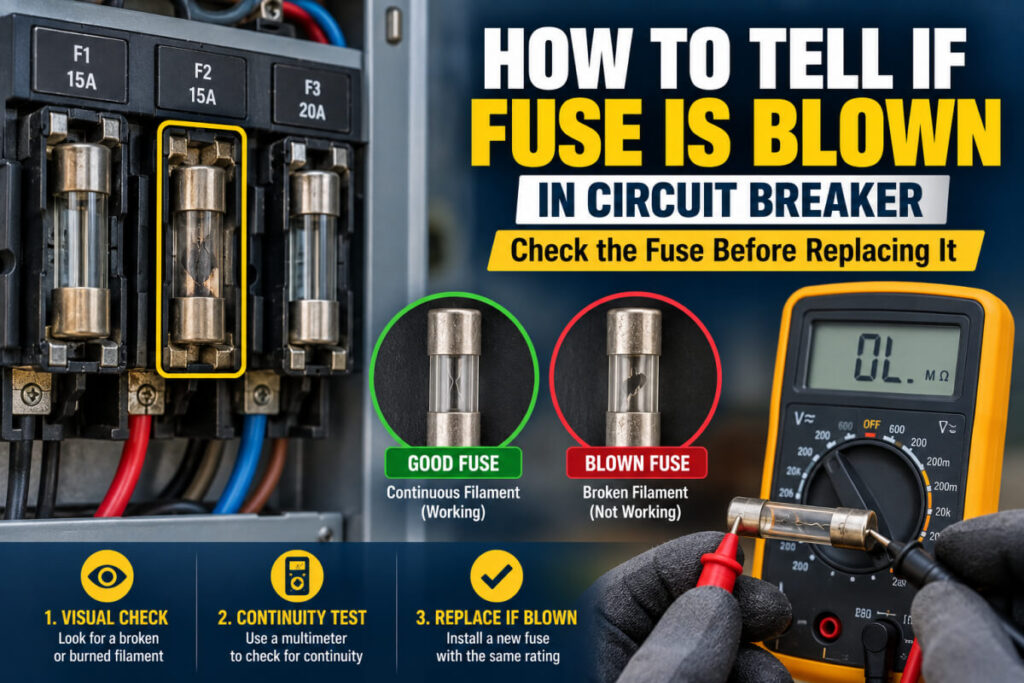
- Inspect each fuse under direct light. Look at the window on screw-in fuses — a broken wire or dark discoloration confirms a blown fuse. On glass cartridge fuses, the internal element is directly visible.
- Note the fuse amperage rating before removal. The rating is stamped on the fuse cap or printed on the label. A fuse that keeps blowing indicates an overcurrent condition that should be diagnosed before replacement.
- Remove the suspected fuse using a fuse puller (for cartridge types) or by unscrewing (for Edison base). Never use pliers or fingers on a live circuit — always verify main power is off first.
How to Check for a Blown Fuse with a Multimeter
For ceramic fuses and any fuse where visual inspection is inconclusive, a multimeter continuity test confirms whether the internal element is intact. This is the same method used to test a circuit breaker without live voltage — it checks continuity rather than measuring live voltage, making it the safest method.
- Set the multimeter to continuity mode (the diode symbol or the symbol that produces a beep). Some meters use resistance (Ω) mode — a reading near zero ohms confirms continuity.
- Remove the fuse from the circuit completely before testing. Testing in-circuit gives false readings from parallel paths.
- Touch one probe to each end of the fuse. For a screw-in fuse, contact the center terminal and the threaded base. For a cartridge fuse, contact each end cap.
- Read the result. A beep or near-zero resistance confirms the element is intact — the fuse is good. No beep or OL (open loop) reading confirms a blown fuse.
- Replace the blown fuse with one of the exact same amperage rating. Using a higher-rated fuse defeats the protection the fuse provides.
❌ Blown Fuse — Multimeter Reads:
OL / open loop / no continuity beep. Resistance reading is infinite. The internal element is broken — the fuse must be replaced.
✅ Good Fuse — Multimeter Reads:
Continuity beep or near-zero ohms (0.0–0.5Ω). Element is intact. If the circuit is still dead, the fault lies elsewhere — check the breaker or the load.
Behavioral Signs That Point to a Blown Fuse
Sometimes the first clue isn’t visual — it’s a dead circuit. Knowing the behavioral pattern helps narrow down whether you’re dealing with a blown fuse, a tripped breaker, or a different fault entirely.
| Symptom | Likely Cause | Check First |
|---|---|---|
| Entire circuit dead — no power to any outlet on one circuit | Blown fuse or tripped breaker | Fuse window or breaker position |
| Circuit dead immediately after heavy load (AC, dryer, heater) | Fuse blown on overcurrent | Fuse amperage vs. load draw |
| Windshield wipers not working, headlights out (vehicle) | Blown headlight fuse or wiper fuse | Fuse box inside vehicle cabin or hood |
| Circuit dead but breaker shows ON and doesn’t reset | Breaker failed internally or blown fuse in panel | Multimeter continuity on breaker/fuse |
| Repeated blown fuses on same circuit | Overcurrent condition or short circuit | Load draw vs. fuse rating; wiring inspection |
A circuit breaker that appears tripped but won’t hold after reset can mimic a blown fuse — both produce a dead circuit with no obvious cause. The distinction matters for troubleshooting: a blown fuse is always replaced, while a failed breaker is replaced or a partial failure repaired differently.
Blown Fuse vs. Tripped Breaker: Key Differences
Modern homes use circuit breakers rather than fuses, but older homes — and many automotive, HVAC, and appliance applications — still use fuse protection. The distinction between a blown circuit breaker fuse and a standard tripped breaker affects what you do next.
- Tripped breaker: The toggle moves to a middle or OFF position. Resetting it (firm push to OFF, then ON) restores the circuit if the fault that caused the trip has been cleared.
- Blown fuse: The fuse must be physically replaced. Resetting does nothing. The circuit stays dead until the correct replacement fuse is installed.
- Failed breaker that mimics a blown fuse: The breaker toggle appears ON but the circuit is dead. Multimeter testing across the breaker terminals confirms whether the breaker is passing voltage — if not, replacing the circuit breaker is the correct repair.
Common Fuse Types and Where to Find Them
Different fuse types appear in different applications. Knowing which type you’re dealing with determines the right inspection method.
| Fuse Type | Common Application | How to Identify Blown |
|---|---|---|
| Edison base (screw-in) | Old breaker box fuses / residential panels | Dark window, broken visible element |
| Glass cartridge (AGC, 3AG) | Appliances, older panels, some HVAC | Visible broken filament, discoloration |
| Blade (ATC/ATO) | Automotive, wiper fuses, headlight fuse | Hold to light — broken element visible |
| Ceramic / time-delay | Motor circuits, HVAC, heavy appliances | Multimeter continuity test only |
| High-current cartridge (FMX/JCase) | Vehicle main fuse boxes, high-amp circuits | Multimeter test; casing may show burn marks |
When a Fuse Keeps Blowing
A fuse that blows repeatedly on the same circuit is telling you something important: the load on that circuit exceeds the fuse’s rated capacity, or there’s a short circuit or ground fault in the wiring or a connected device. Replacing the fuse without addressing the cause means the next fuse will blow too. The correct diagnostic process checks the total load draw against the circuit rating, inspects the wiring and receptacles for damage, and tests connected appliances or equipment one at a time to isolate the fault. If the circuit continues tripping or blowing under normal load, the circuit itself needs professional evaluation.
Frequently Asked Questions
How Do You Know If a Fuse Is Blown?
On glass or screw-in fuses, inspect the window — a broken element or dark discoloration confirms a blown fuse. For ceramic fuses with no visible window, use a multimeter set to continuity mode: no beep or OL reading confirms the fuse has blown. Behavioral signs include a dead circuit that doesn’t restore when the breaker is reset.
What Does a Blown Fuse Look Like?
In a glass fuse, the metal filament inside is visibly broken, melted, or the glass is darkened or blackened where the element failed. In a screw-in Edison fuse, the small viewing window shows a broken wire or burn mark. Blade fuses show a broken element when held to light. Ceramic fuses show no visible change — testing is required.
Can You Check a Fuse Without Removing It?
In some cases — a voltage test across each end of the fuse with the circuit energized can confirm whether voltage is present on both sides (fuse good) or only the input side (fuse blown). However, removing the fuse and testing continuity with the circuit de-energized is the safer and more reliable method.
How to Check for a Blown Fuse in a Breaker Box?
Turn off the main breaker, open the panel, and visually inspect each fuse for a broken element or darkened window. Use a multimeter in continuity mode to test any fuse where visual inspection is inconclusive — remove the fuse from the circuit first, then probe each end. No continuity confirms a blown fuse.
What Happens If You Put a Higher Amp Fuse In?
The fuse provides less protection than the circuit wiring requires. It allows higher current to flow through wiring rated for a lower load — the wiring overheats before the fuse trips. This is a fire risk and a code violation. Always replace a blown fuse with one of the same amperage rating.
Need Reliable Circuit Protection Components?
Dvolt manufactures MCBs and circuit protection devices built to consistent tolerances for residential and commercial electrical systems.
Contact Our Team Browse Our ProductsFinal Thoughts
Knowing how to tell if a fuse is blown in a circuit breaker box comes down to two methods: visual inspection for glass and screw-in fuses, and multimeter continuity testing for ceramic or any fuse where the element isn’t visible. A dead circuit that doesn’t respond to breaker reset is the primary behavioral clue. Always replace a blown fuse with one of the exact same amperage rating — and if the same fuse keeps blowing, the underlying overcurrent condition needs to be diagnosed before the next replacement goes in.