Finding the Right Breaker for Dead Outdoor Outlets — GFCI Reset, Panel Identification, and When to Call an Electrician
A dead outdoor outlet is one of the more frustrating electrical problems to troubleshoot because the breaker that controls it isn’t always where you’d expect. Most homeowners go straight to the main panel, find nothing obviously tripped, and assume the problem is more serious than it is. In most cases, the outdoor outlet is controlled by a GFCI receptacle somewhere inside the house — and that GFCI has tripped, not the panel breaker. Knowing where to look, in what order, gets the outlet working again in minutes rather than an afternoon.
This guide covers where the circuit breaker for an outdoor outlet is located, the difference between a panel breaker and a GFCI-controlled outlet, how to systematically find and reset the right device, and what the outdoor outlet not working after rain or other weather events usually means.
Where Is the Circuit Breaker for Outdoor Outlets?
Outdoor outlets in residential properties are controlled by one of two protection devices — and in many homes, by both in series. Understanding how these are wired together is the key to finding the right device to reset.
📍 GFCI Receptacle (Most Common)
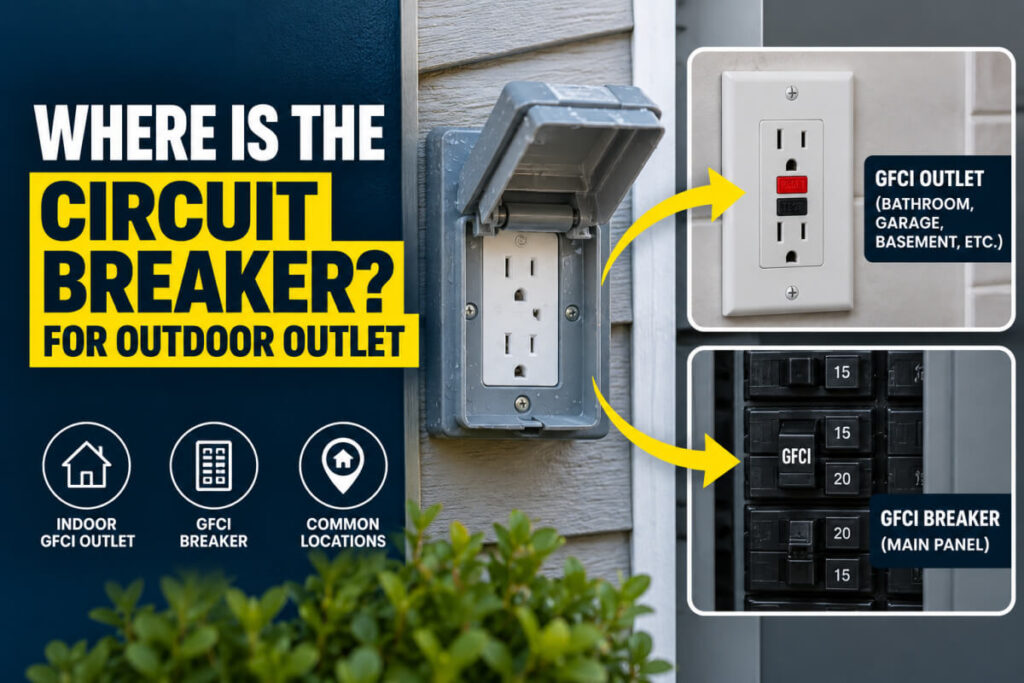
A GFCI outlet installed inside the house — typically in the bathroom, garage, basement, or utility room — protects downstream exterior outlets on the same circuit. When this GFCI trips, all downstream outdoor outlets go dead. The reset button is on the GFCI receptacle face, not at the panel. This is the most common reason for outdoor outlets not working.
📍 Panel Breaker (GFCI Breaker)
Some installations protect outdoor outlets with a GFCI circuit breaker in the main panel rather than a GFCI receptacle. In this case, the breaker at the panel is the only reset point. GFCI breakers have a TEST button on their face and a white wire pigtail that connects to the panel neutral bar — distinguishing them from standard breakers.
📍 Outdoor GFCI Outlet
In some newer installations, the exterior outlet itself is a GFCI receptacle with its own reset button, protected by an in-use weatherproof cover. Look for the TEST and RESET buttons directly on the outdoor outlet face before checking anywhere else — a tripped outdoor GFCI outlet is a straightforward self-contained reset.
📍 Standard Circuit Breaker in Main Panel
Older installations and post-2002 code-compliant new work without GFCI outlets route outdoor circuits through a dedicated breaker in the main panel. In modern work, this breaker is a GFCI type. In pre-2002 homes, it may be a standard breaker with no GFCI protection — though this is no longer code-compliant for exterior locations.
How to Find the Circuit Breaker for an Outdoor Outlet
When all outdoor outlets stop working, work through these locations in order — most problems resolve at the first or second step without needing to touch the main panel at all.
-
Check the outdoor outlet face first. Look for TEST and RESET buttons directly on the outlet. If present, press RESET firmly. If it clicks and holds, the outlet was a self-contained GFCI that had tripped — you’re done.
-
Check GFCI receptacles in the bathroom. The NEC has historically grouped bathroom and exterior outlets on shared GFCI-protected circuits. A tripped bathroom GFCI kills outdoor outlets on the same circuit. Look for a receptacle with TEST and RESET buttons — usually on the countertop outlet nearest the sink.
-
Check the garage GFCI receptacle. Garage outlets are required to be GFCI-protected, and in many homes the garage GFCI protects the exterior outlets as well. Check all GFCI receptacles visible on the garage walls — the tripped one will have its RESET button popped out slightly.
-
Check basement, utility room, and crawl space GFCI outlets. Some wiring runs include a GFCI in a less-obvious location — the basement, a utility corridor, or a crawl space. These protect wet-area circuits including exterior outlets. Opening the electrical panel is only necessary if these receptacle checks all come back with no tripped GFCI found.
-
Go to the main panel and look for the outdoor circuit breaker. Check all breakers for a tripped position — the toggle in a middle or slightly OFF position, often with a red indicator window visible. If the panel has labeled circuits, look for labels indicating “exterior,” “outdoor,” “patio,” or “front porch.” If no circuit is labeled, look for any GFCI-type breaker (with a white pigtail and TEST button) in a tripped position.
-
Reset the breaker correctly. Push the tripped breaker firmly to OFF first, then push it fully to ON. A breaker that won’t hold in the ON position — or trips again immediately — indicates an active fault in the circuit or a breaker that has failed internally and needs replacement.
Do Outdoor Outlets Need to Be GFCI Protected?
Yes — the NEC requires GFCI protection for all outdoor receptacles in residential applications, without exception. This has been the code requirement since 1978 for residential exterior outlets, and the requirement has expanded with each subsequent NEC edition. Since 2002, all outdoor receptacles installed in new construction must be GFCI protected regardless of height or location.
Additionally, outdoor outlets are required to be weatherproof — a WR (Weather Resistant) rated receptacle is mandatory for all outdoor locations per NEC 406.9. Outdoor outlets with an in-use cover that remains closed while a plug is inserted are the current standard for residential exterior locations. Whether outdoor outlets need to be on their own circuit is a separate question — they are not required to be, but dedicated outdoor circuits are common in larger homes and are good practice for high-draw applications like outdoor kitchens and power tools.
Why Is My Outdoor Outlet Not Working?
Beyond a tripped GFCI or panel breaker, there are several other causes of a dead outdoor outlet. The table below maps the most common symptoms to likely causes to help narrow down the problem before opening anything.
| Symptom | Most Likely Cause | First Check |
|---|---|---|
| All outdoor outlets dead simultaneously | Tripped GFCI upstream (bathroom, garage, or basement) | GFCI receptacles inside the house |
| Outdoor outlet not working after rain | GFCI tripped by moisture ingress; wet outlet box or cover damaged | GFCI reset; inspect outlet cover gasket |
| Front porch outlet not working, others fine | Separate circuit or downstream from different GFCI than other exterior outlets | Check GFCI receptacles in areas near the front of the house |
| Outdoor outlet dead, no tripped breaker or GFCI found | GFCI in unexpected location (crawl space, junction box); wiring fault | Systematic GFCI search; voltage test at outlet |
| Outdoor outlet intermittent — works sometimes | Loose wiring connection at outlet, junction box, or GFCI; failing GFCI | Inspect outlet terminals and connections |
| Outdoor receptacle not working after a circuit reset | GFCI itself has failed; downstream outlet wiring fault | Replace GFCI; test for short in wiring |
How to Reset an Outdoor Outlet
Once you’ve located the controlling device — whether a GFCI receptacle or a panel breaker — resetting correctly matters. An incorrect reset attempt can damage a GFCI or mask a wiring fault.
- Unplug everything from the outdoor outlet before attempting any reset. An active fault from a connected device will cause an immediate re-trip.
- If resetting a GFCI receptacle: Press the RESET button firmly until it clicks and stays in. If it pops back out immediately, the GFCI has detected a fault on the circuit — do not continue forcing the reset.
- If resetting a panel breaker: Push the toggle firmly to the full OFF position first, then push firmly to ON. A breaker that won’t stay on indicates a fault or a breaker that won’t reset under load.
- Test the outdoor outlet with a known working device — a plug-in lamp or phone charger. If power is restored, plug devices back in one at a time to identify if a specific device was causing the trip.
- If the outlet trips again with no load, the fault is in the wiring or the outlet itself — not in the connected equipment. At this point, a voltage test and wiring inspection are needed. If the GFCI breaker or standard breaker needs replacement, the panel should be de-energized at the main before any breaker swap is attempted.
Outdoor Electrical Panel and Exterior Circuit Breaker Boxes
Some properties — particularly larger homes, properties with detached garages, pool houses, or agricultural outbuildings — have an exterior circuit breaker panel or outdoor breaker box in addition to the main indoor panel. These weatherproof circuit breaker boxes serve as sub-panels for the structures or circuits they supply. If your outdoor outlets are fed from a detached structure or a separate outdoor service panel, the relevant GFCI breaker or circuit breaker will be in that sub-panel rather than the main interior panel. Exterior electrical panels are rated for outdoor installation and use weatherproof enclosures — the same reset procedure applies, and adding capacity to an outdoor sub-panel follows the same breaker upgrade process as an indoor panel.
Frequently Asked Questions
Where Is the Circuit Breaker for My Outdoor Outlet?
In most residential homes, outdoor outlets are protected by a GFCI receptacle located inside the house — usually in the bathroom, garage, or basement — rather than a dedicated breaker at the main panel. Check GFCI receptacles inside before going to the panel. If no tripped GFCI is found, look for a GFCI-type or standard circuit breaker in the main panel labeled “outdoor,” “exterior,” or “patio.”
Why Are All My Outdoor Outlets Not Working?
The most common cause is a tripped GFCI receptacle inside the house — one GFCI can protect multiple downstream outdoor outlets simultaneously. Check GFCI receptacles in the bathroom, garage, and basement. The tripped GFCI will have its RESET button popped out. Press RESET firmly to restore power to all the outlets it protects.
Can’t Find the GFCI for My Outside Outlets?
Check all GFCI receptacles in the bathroom, kitchen, garage, basement, crawl space, and utility room. In some installations, the GFCI is in a junction box in an unfinished area rather than a visible wall receptacle. If no GFCI is found, the outdoor outlets may be protected by a GFCI circuit breaker in the main panel — look for breakers with a white pigtail and TEST button.
Should Outdoor Outlets Be GFCI Protected?
Yes — all outdoor outlets are required to be GFCI protected under NEC 210.8(A)(3) for residential dwelling units. This requirement applies to all new construction and to any outlet that is replaced or added in an outdoor location. A non-GFCI outdoor outlet is a code violation in any post-1978 installation.
How Do I Reset an Outdoor Outlet That Won’t Work?
First, unplug all devices from the outdoor outlet. Then locate the controlling GFCI — either at the outlet face itself, inside the house (bathroom/garage/basement), or as a GFCI breaker in the main panel. Press the RESET button firmly. If the reset won’t hold, there is an active fault in the circuit — the wiring or the outlet itself needs inspection before restoring power.
Need GFCI Breakers or Circuit Protection Components?
Dvolt manufactures MCBs and circuit protection devices built to NEC-compliant standards for residential and commercial electrical systems.
Contact Our Team Browse Our ProductsFinal Thoughts
The circuit breaker for an outdoor outlet is almost never the first place to look — it’s the last. Most dead exterior outlets are controlled by a GFCI receptacle inside the house, and resetting that GFCI restores power without ever touching the panel. Work from outside in: check the outlet face, then bathroom and garage GFCI receptacles, then basement and utility areas, and only then the main panel. If the outdoor outlet continues to trip after reset with no load connected, the circuit has a wiring or device fault that needs proper diagnosis rather than another reset attempt.