What Happens to Your AC System When the Contactor Fails — Symptoms, Risks, and Why This Is Never a Wait-and-See Repair
The short answer is: sometimes, briefly, and never safely. An AC unit with a bad contactor may still run in certain failure modes — but the operating conditions it creates are damaging to the compressor, dangerous to anyone working near the unit, and in some failure modes, a fire risk. Understanding what a bad contactor actually does to AC system operation is the difference between diagnosing the problem correctly on the first visit and replacing components that didn’t need replacing.
This guide covers what happens when an AC contactor goes bad, the different ways a failing contactor manifests in system behavior, how to identify whether the contactor is the cause of the problem, and why a bad contactor is always a replacement — never a repair-and-monitor situation.
What Is an AC Contactor and What Does It Do?
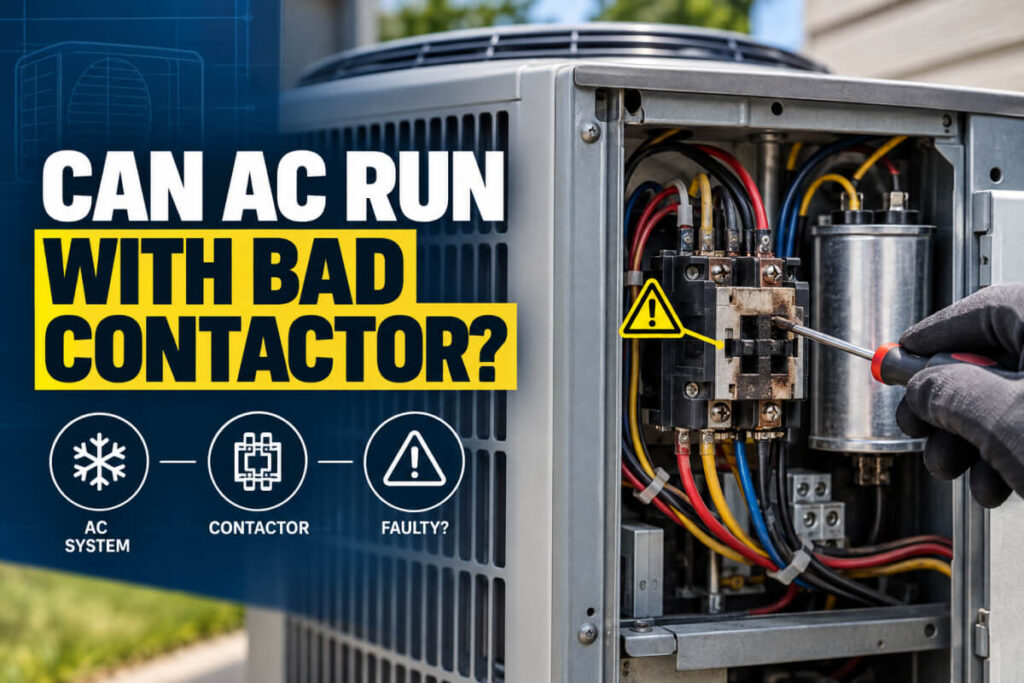
An AC contactor is an electrically operated switch inside the condenser unit that controls 240V power to the compressor and condenser fan motor. When the thermostat sends a 24V signal to the contactor coil, the coil generates a magnetic field that pulls the contact plunger down, closing the main contacts and completing the 240V circuit to the compressor. When the thermostat signal stops, the coil de-energizes, a spring returns the plunger, and the contacts open — cutting power to the compressor.
This switching cycle happens dozens of times per day in normal operation. Each switching event creates a small arc across the contacts. Over time — typically 5 to 10 years in a residential system — this arc erosion pits and degrades the contact surfaces until the contactor can no longer switch reliably. Understanding what a contactor does in an HVAC system makes clear why its failure has such direct consequences for system operation.
Can AC Run with a Bad Contactor? The Two Failure Modes
Whether an AC unit can run with a bad contactor depends entirely on how the contactor is failing. There are two primary failure modes — and they produce opposite symptoms.
❌ Failure Mode 1: Contactor Won’t Close
The contactor coil receives the 24V signal but the contacts don’t close, or close intermittently. The compressor and fan don’t start — or start and immediately stop. The AC unit won’t cool. Thermostat is calling for cooling but nothing happens at the condenser. This is the most common bad contactor symptom and the cleaner failure mode.
🔥 Failure Mode 2: Contactor Contacts Are Welded Closed
Pitted contacts fuse together under arc heat and the contactor physically cannot open. The compressor and fan run continuously — even when the thermostat is satisfied and has stopped calling for cooling. The AC runs without stopping, the house gets too cold, and the compressor eventually fails from running without adequate load. This is the more dangerous failure mode.
In Failure Mode 1, the AC cannot run at all — or runs sporadically. In Failure Mode 2, the AC runs continuously when it shouldn’t. Neither condition is safe for continued operation, and neither is a situation where the answer is “it’s still working, we’ll deal with it later.”
Signs of a Bad AC Contactor
The symptoms of a failing contactor are usually identifiable before the unit fully stops cooling. Knowing what to look for allows earlier intervention — before the compressor is damaged by operating in abnormal conditions.
🔇 AC Unit Humming But Not Starting
The contactor coil is energized (you can hear the hum) but the contacts aren’t closing. Power isn’t reaching the compressor. Common when contact surfaces are heavily pitted.
🔁 AC Starts and Stops Immediately
Contacts close long enough for startup, then arc open again under load. Short-cycling that’s traced to the contactor rather than refrigerant or thermostat issues.
🌡️ AC Won’t Turn Off
Welded contacts keep the compressor running after the thermostat is satisfied. The unit never cycles off — the house overcools and the compressor runs unloaded.
⚡ Chattering or Buzzing Sound at Condenser
The contactor is rapidly making and breaking contact — coil voltage may be low, or contact surfaces are degraded. Audible chattering from the condenser cabinet is a specific contactor symptom.
🔥 Visible Burns or Pitting on Contacts
When you inspect the contactor visually, the contact surfaces show blackening, cratering, or welding. Physically checking the AC contactor for contact condition is a standard diagnostic step.
🌡️ No Voltage at Compressor Despite Thermostat Call
Voltage is present at the contactor line terminals (L1/L2) but absent at the load terminals (T1/T2) when the thermostat is calling for cooling. Confirmed with a voltmeter — contacts are open when they should be closed.
How to Diagnose a Bad AC Contactor
A systematic diagnosis confirms the contactor is the fault before ordering parts. Several of these checks can be done safely with basic tools — but the 240V terminals require appropriate precaution and a non-contact voltage tester.
-
Check the thermostat is calling for cooling. Set the thermostat to COOL mode and lower the setpoint well below room temperature. Confirm the system is calling — the thermostat display should show active cooling mode. If the thermostat isn’t sending a signal, the contactor coil won’t energize regardless of its condition.
-
Listen at the condenser for the contactor click. When the thermostat calls for cooling, you should hear a distinct click from the contactor engaging inside the condenser cabinet. No click = coil isn’t pulling in the plunger. A click with no compressor start = contacts aren’t closing or compressor has a separate issue.
-
Check for 24V at the contactor coil terminals. With the thermostat calling, use a voltmeter at the A1 and A2 coil terminals on the contactor. 24V present = the thermostat circuit is working correctly and the coil is being powered. No voltage = the problem is upstream in the control circuit, not the contactor itself. Understanding what A1 and A2 on an AC contactor mean is essential for this test.
-
Check for 240V at the load terminals (T1/T2) when contactor should be closed. With the thermostat calling and 24V confirmed at the coil, use a voltmeter at the T1 and T2 load terminals. No voltage here with voltage at the line terminals = contacts aren’t closing — bad contactor confirmed.
-
Visually inspect the contact surfaces. With power fully disconnected at the disconnect box, open the condenser cabinet and inspect the contactor face. Heavily pitted, burned, or welded contact surfaces confirm replacement is needed regardless of other test results. A full contactor inspection walkthrough covers every visual and electrical check in detail.
What Happens to the Compressor When the Contactor Is Bad
A bad contactor doesn’t just leave the AC not cooling — it actively damages the most expensive component in the system. The compressor depends on the contactor for proper start and stop cycles. When the contactor fails, the compressor operates outside its design parameters in ways that accelerate failure.
| Contactor Failure Mode | Effect on Compressor | Timeline to Compressor Damage |
|---|---|---|
| Won’t close — compressor can’t start | No immediate compressor damage; heat builds in capacitor and motor winding from failed start attempts | Days to weeks of failed starts can damage start capacitor and motor windings |
| Intermittent contact — compressor short-cycles | Repeated high-current start events stress motor windings; compressor never reaches operating temperature for oil circulation | Weeks — compressor bearing wear accelerated by inadequate lubrication during short cycles |
| Welded closed — compressor runs continuously | Compressor runs with no load once house reaches setpoint; liquid refrigerant floods compressor; motor overheats from no-load operation | Hours to days — liquid slugging can destroy compressor valves quickly |
The welded-contact failure mode is particularly destructive because the compressor continues running with no load — refrigerant floods back to the compressor in liquid form, the valves are damaged, and the motor overheats. Replacing the contactor early is a fraction of the cost of the compressor damage a stuck-closed contactor causes.
Frequently Asked Questions
Can AC Run with a Bad Contactor?
Sometimes, in limited ways — but never safely. If the contactor fails in the closed position, the AC runs continuously even when it shouldn’t, damaging the compressor. If it fails open, the AC won’t run at all. Either failure mode requires immediate replacement — a bad contactor is not a wait-and-see situation.
What Does a Bad AC Contactor Sound Like?
A chattering or buzzing sound from the condenser cabinet is the most distinctive audio symptom — the contactor is rapidly making and breaking contact. A humming condenser with no compressor starting also indicates the contactor coil is energized but contacts aren’t closing. A completely silent condenser when the thermostat is calling suggests no coil voltage or a failed coil.
How Long Can You Run AC with a Bad Contactor?
You should not continue running the AC with a known bad contactor. In the welded-closed failure mode, damage to the compressor can occur within hours. In the won’t-close failure mode, the AC provides no cooling while repeated failed start attempts stress the start capacitor and motor windings. Contactor replacement is typically a same-day repair — there’s no reason to delay.
Can a Bad Contactor Cause the AC to Keep Running?
Yes — this is Failure Mode 2, where the contact surfaces weld together under arc heat and the contactor physically cannot open. The compressor and fan run continuously regardless of thermostat position. The only way to stop the unit is to disconnect power at the condenser disconnect box or trip the circuit breaker at the panel.
How Much Does It Cost to Replace an AC Contactor?
A residential AC contactor typically costs $15 to $45 for the part. Professional installation including diagnosis runs $75 to $200 depending on market and contractor. The part itself is one of the more affordable components in an HVAC system — far less than the compressor damage a stuck contactor can cause if left unaddressed. The contactor not pulling in is always worth diagnosing immediately rather than deferring.
Need a Quality Replacement Contactor?
Dvolt manufactures contactors and switching components built to consistent tolerances for residential and commercial HVAC applications — the right spec, reliably.
Contact Our Team Browse Our ProductsFinal Thoughts
An AC unit with a bad contactor can technically run — but only in failure modes that damage the compressor, waste energy, or both. There is no safe version of operating a system with a known bad contactor. The symptoms are identifiable: a unit that won’t start, a unit that won’t stop, chattering from the condenser cabinet, or voltage confirmed at the coil with no voltage passing through to the compressor. In every case, the contactor is a straightforward, affordable replacement — and one that protects the far more expensive compressor from the consequences of delayed repair.