How to Reset an AC Contactor, Restart a Non-Responsive Condenser, and Diagnose When Reset Won’t Fix It
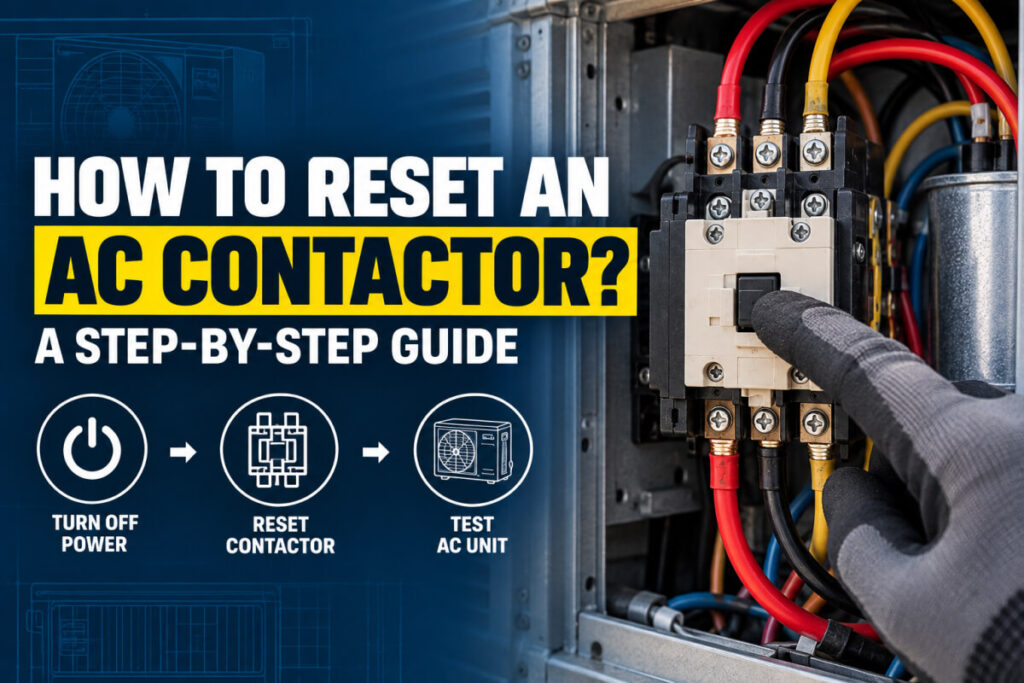
When an air conditioner stops cooling and the outdoor condenser unit isn’t running, the instinct is to reset something. The problem is that an AC contactor doesn’t have a reset button — it’s a switching relay, not a circuit breaker. What most people are actually doing when they “reset the AC contactor” is either resetting the circuit breaker at the panel, resetting the high-pressure or thermal limit switch on the unit, or power-cycling the system to allow a faulted contactor to attempt to re-engage. Understanding the difference between these steps determines whether the reset actually works and what to do when it doesn’t.
This guide covers the full reset sequence for a non-responsive AC condenser — from the outdoor unit reset button through the panel breaker and back to a contactor diagnosis — and explains when a reset is a real fix versus a sign that the contactor itself needs to be replaced.
What Does “Resetting an AC Contactor” Actually Mean?
The confusion around resetting an AC contactor comes from the fact that several different components can cause a non-responsive condenser — and each one has a different reset procedure. Before doing anything, it helps to understand which component is being reset and why.
🔌 Circuit Breaker Reset
The most common actual fix — the circuit breaker for the AC condenser has tripped at the main panel or the sub-panel. A tripped breaker cuts 240V to the contactor line terminals, so the contactor has nothing to switch even if it’s working perfectly. Resetting the breaker restores voltage to the system.
🔴 Outdoor Unit Reset Button
Many condensers have a small red or black reset button on the outside of the unit — usually on the compressor housing or the lower exterior panel. This is a high-pressure or thermal overload reset switch, not a contactor reset. It trips when the compressor overheats or pressure limits are exceeded.
⚡ Power Cycle (Soft Reset)
Turning the thermostat off, waiting 30 seconds, and turning it back on allows the 24V control signal to de-energize and re-energize the contactor coil. This clears a contactor that failed to pull in due to a momentary voltage drop or a brief control circuit fault — not a fix for a mechanically failed contactor.
🌡️ Thermostat Reset
The thermostat controls the 24V signal that tells the contactor coil to close. A thermostat that has locked out due to a fault code, a tripped safety circuit, or a failed mode switch will prevent the contactor from ever receiving its activation signal — regardless of the contactor’s own condition.
How to Reset an AC Contactor: The Complete Sequence
Work through this sequence in order. Most non-responsive condensers are restored at step 1 or 2 — the contactor itself only becomes the subject of diagnosis if earlier steps don’t restore operation.
-
Set the thermostat to OFF and wait 30 seconds. This fully de-energizes the 24V control circuit and allows any transient fault condition to clear. Do not skip this step — attempting to restart a condenser that is mid-cycle or in a fault state can prevent the reset from taking effect.
-
Check the outdoor unit reset button. Walk to the condenser unit and inspect the exterior housing — typically on the compressor housing near the base of the unit or on a side panel. Look for a small raised button, often red or black, labeled RESET. Press it firmly until you feel it click. This resets the compressor’s thermal overload or high-pressure limit switch if it has tripped. If the button feels stuck or won’t stay in, the compressor is still in an overheated or high-pressure condition — allow the unit to cool for 30 minutes before pressing again. This is the outdoor AC unit reset button that many homeowners overlook before going to the panel.
-
Check and reset the circuit breaker at the main panel. Go to the main panel and locate the double-pole breaker serving the AC condenser — typically labeled “AC,” “Air Conditioner,” “Condenser,” or “HVAC.” A tripped breaker will be in the middle position or slightly off-center. Push it firmly to OFF first, then back to ON. A circuit breaker that trips again immediately after reset indicates an active fault in the circuit — do not keep resetting it.
-
Check the disconnect box at the condenser. The weather-resistant disconnect box mounted near the condenser unit contains either a pull-out fuse block or a disconnect switch. Pull out the fuse block or switch it to OFF, wait 10 seconds, and restore it. On units with fuses in the disconnect, inspect the fuses — a blown fuse is a common cause of a contactor that never sees voltage on its line terminals regardless of its own condition.
-
Restore thermostat and test. With all resets completed, set the thermostat to COOL mode with the setpoint 4–5 degrees below room temperature. Go outside and listen for the contactor click within 30–60 seconds of the thermostat calling for cooling. A distinct click followed by compressor and fan startup means the system is running. No click means the contactor coil is not being energized — the 24V control circuit needs diagnosis. A click with no compressor startup means the contacts are not passing voltage — the contactor has failed mechanically.
-
If the system runs but shuts down again within minutes, the compressor is tripping its thermal protection due to an underlying issue — low refrigerant, dirty condenser coils, or a failing compressor. Allow the unit to cool for 30–60 minutes, clean the condenser coils if visibly dirty, and check for refrigerant charge signs (ice formation on the line set, insufficient cooling despite the compressor running).
How to Test an AC Contactor After Reset
If the reset sequence above doesn’t restore the system, the next step is confirming whether the contactor itself is functioning. This requires a multimeter and takes about 10 minutes with the system safely de-energized at the disconnect.
-
De-energize the unit at the condenser disconnect box. Pull out the disconnect block or switch to OFF. Wait 5 minutes for the run capacitor to discharge before opening the cabinet.
-
Check the contactor coil terminals (A1 and A2). With the thermostat calling for cooling, use a voltmeter to check for 24V AC at the A1 and A2 coil terminals on the contactor (restore disconnect briefly for this test — exercise caution around 240V terminals). 24V present at the coil = the thermostat and control circuit are working; the coil or contacts are the fault. No 24V = the issue is upstream in the control circuit, not the contactor. Understanding what A1 and A2 on the AC contactor mean is essential for this diagnosis step.
-
Check the contact surfaces visually. With the disconnect pulled and the cabinet open, inspect the contactor face. Blackened, pitted, or welded contact surfaces — visible as dark cratering on the metal contact pads — confirm the contactor is at end of life regardless of whether it appears to be closing. Testing the AC contactor fully with a continuity check across the load terminals confirms whether the contacts are passing current when closed.
Reset Outcomes and What They Mean
✅ Reset Works — System Runs Normally
Breaker or thermal reset was the fix. The contactor itself is functioning. Monitor the system for the next few run cycles — if it doesn’t trip again, the cause was a one-time condition (power surge, momentary overcurrent, compressor hot start).
❌ Reset Works But Trips Again Within Days
The contactor’s contact surfaces are worn — intermittent failure that restores briefly but degrades further with each switching cycle. Replacement is the correct repair, not repeated resets. This is also a sign the capacitor may be weakening, extending start draw and stressing contacts.
✅ Breaker Reset Holds — Condenser Starts
A one-time trip from a transient fault or high-ambient restart. The contactor is functioning. Check the condenser coils for fouling and ensure the system has adequate airflow — high-ambient conditions and restricted airflow cause legitimate breaker trips that are not fault conditions.
❌ No Response After All Reset Steps
Systematic diagnosis required — either the contactor coil is failed (no 24V signal reaching it, or coil burned open), the contacts are welded or open, or the compressor itself has failed and is drawing locked rotor amps that prevent any startup. Confirming whether the AC contactor is bad through voltage and continuity testing identifies which component is the fault.
When Reset Is Not Enough: AC Contactor Replacement
An AC contactor that requires repeated resets, fails to respond to a confirmed 24V coil signal, or shows visibly burned contact surfaces is past the point where reset is a useful intervention. The contactor is a wear component with a finite switching cycle life — typically 5 to 10 years in residential use. Once the contact surfaces are pitted below the point of reliable conduction, each switching event worsens the condition.
| Symptom After Reset | Likely Component | Next Action |
|---|---|---|
| System runs, trips again in 1–3 days | Contactor contacts worn; possibly capacitor weak | Replace contactor; test capacitor |
| Breaker trips immediately on reset | Short circuit, locked rotor, or ground fault | Professional diagnosis — do not re-reset |
| No click when thermostat calls, 24V confirmed at coil | Contactor coil burned open | Replace contactor |
| Click confirmed, compressor doesn’t start | Contactor contacts open (won’t pass voltage), or failed capacitor/compressor | Voltage test at load terminals; check capacitor |
| AC won’t shut off after reset | Contactor contacts welded closed | Cut power at disconnect; replace contactor immediately |
| Outdoor reset button won’t stay in | Compressor still overheated or refrigerant pressure issue | Allow 30-min cooldown; check refrigerant, airflow |
Replacing the contactor is a straightforward repair — the part costs $15 to $40 and the installation involves disconnecting a handful of wires and swapping the component. The full cost to replace an AC contactor is significantly less than the compressor damage that a failing contactor causes when it’s left in service past its useful life.
How to Reset AC Compressor and Condenser: What’s Different
The terms “reset AC compressor” and “reset AC condenser” are often used interchangeably with “reset AC contactor” — they all refer to restoring a non-responsive outdoor unit. The practical steps are the same: outdoor reset button first, then the disconnect, then the panel breaker, then the thermostat cycle. The compressor itself has internal thermal protection that resets automatically after it cools down — the outdoor reset button on the unit housing accesses this protection manually when automatic reset hasn’t occurred. An AC contactor not pulling in after a full reset sequence is a contactor problem, not a compressor reset issue.
Frequently Asked Questions
How Do You Reset an AC Contactor?
An AC contactor doesn’t have a reset button — it’s a magnetic relay, not a circuit breaker. To restore a non-responsive condenser, the reset sequence is: (1) thermostat to OFF for 30 seconds, (2) press the outdoor unit reset button if present, (3) reset the circuit breaker at the main panel, (4) restore the condenser disconnect. If the system still won’t run after this sequence, the contactor itself needs testing and likely replacement.
Where Is the Reset Button on an AC Contactor?
There is no reset button on an AC contactor itself — the reset button found on condenser units is on the compressor’s thermal overload protector, located on the compressor housing or the lower exterior panel of the condenser cabinet. It resets the compressor’s internal protection, not the contactor relay.
How Do You Reset an AC Compressor?
To reset an AC compressor: set the thermostat to OFF, locate the reset button on the condenser unit exterior (typically a raised red or black button on the compressor housing), press it firmly until it clicks, then wait 30 minutes before attempting to restart. This resets the compressor’s thermal overload protection. If the button won’t stay in, the compressor is still overheated — wait longer before pressing again.
Why Does My AC Contactor Keep Tripping?
If the condenser keeps losing power, the most likely causes are: a tripping circuit breaker due to overcurrent from worn contacts or a failing compressor, a thermal overload on the compressor tripping from overheating or restricted airflow, or a weakening contactor that makes intermittent contact under load. A system that trips repeatedly needs diagnosis — repeated resets without identifying the cause will eventually result in compressor damage.
How Long Does It Take for an AC Contactor to Reset?
The contactor itself re-engages immediately when the 24V coil signal is restored — there is no cooldown required for the contactor relay. What requires cooldown is the compressor’s thermal overload protection — after the compressor overheats and trips, allow 20–30 minutes for it to cool before attempting to restart. Resetting before the compressor has cooled will result in another immediate trip.
Need a Reliable Replacement Contactor?
Dvolt manufactures contactors and switching components built to consistent tolerances for residential and commercial HVAC applications.
Contact Our Team Browse Our ProductsFinal Thoughts
Resetting an AC contactor is really a sequence of checks across the outdoor reset button, the disconnect, and the panel breaker — the contactor itself doesn’t reset. When the sequence restores operation and the system runs reliably, the reset was genuine. When the system trips again within days, the contactor’s contact surfaces are worn and replacement is the correct repair. The reset is always worth doing first — it takes five minutes and costs nothing. But a contactor that can only be kept alive through periodic resets is already past its service life, and every restart cycle it fails is another opportunity for the compressor to sustain damage from the conditions that follow.